| Resurrection Home | Previous issue | Next issue | View Original Cover |
Computer
RESURRECTION
The Journal of the Computer Conservation Society
ISSN 0958-7403
|
Number 112 |
Winter 2026/27 |
| Society Activity | |
| News Round-Up | |
| Chairman’s Report for 2025/26 | Chris Rees |
| A Tribute to Dik Leatherdale, our Retiring Editor | Martin Campbell-Kelly |
| Changes at The National Museum of Computing | Andrew Herbert |
| An Elliott 803B in a Browser | Luís Simões da Cunha |
| The Manchester Ferranti computer | Jonathan P. Bowen |
| The Tony Sale Award | Martin Campbell-Kelly |
| Three experiments with Algol 60 | David Holdsworth |
| “The 12 Days of Xmas” according to Algol 68 | Richard Gordon |
| Celebrating 75 Years of LEO I’s World Changing First Production Run | Peter Byford |
| Forthcoming Events | |
| Museums | |
| Committee of the Society | |
| Aims and Objectives |
|
EDSAC — Andrew Herbert My last few reports have reported on the ongoing battle to make EDSAC Initial Orders work. The good news is that we are now seeing the store correctly loaded when the START button is pressed. There is still some residual tidying up required, but overall Initial Orders can now be regarded as functional. The work on Initial Orders required many aspects of the rest of the machine to be revisited, especially in the area of Main Control. Initial Orders work by changing a key control signal so that Main Control, rather than reading orders in sequence as it does for normal execution, copies data from the Initial Orders uniselectors to the store. Compared to normal execution, Initial Orders run at the slow speed of the uniselectors. This showed up several flaws in the Main Control circuit design where these matters had either not been anticipated, or the additional control inputs to “divert” Main Control into Initial Orders mode not previously exercised. And, as we have discovered throughout the project, EDSAC is very sensitive to small changes in signal timing or level due to circuit modifications or additions causing previously working things to fail. Tony Abbey is to be congratulated for his persistence in getting the Initial Orders system working. I should also mention a new volunteer who has joined us – Alaric Nicoll – who has just finished a master’s degree at Southampton University and is about to embark on a PhD. 50 years younger than most of rest of the team, Alaric has shown us that being a student of modern electronics is no impediment to getting to grips with valve circuits. Martin Evans continues to progress with the paper tape reader electronics, although he has come to a temporary halt while he recovers from recent surgery. We wish him well and look forward to having him rejoin the team in six weeks’ time. Nigel Bennee continues to recommission the Arithmetic Unit and we are now back to having some of the basic arithmetic functions and jumps operational. Peter Linington and Peter Haworth continue to work on testing and improving the reliability of the nickel delay line stores. Our replica has now been operating for longer than the original machine (at least in terms of calendar years, although not in terms of running hours) and maintenance is starting to become an issue. We are seeing a MTBF of about five hours, with valves going “soft” or otherwise deteriorating as the principal cause of failures. We are undertaking two courses of action to mitigate these problems. We are removing each valve from the machine, starting from the most critical areas, testing them and lubricating their pins with conductive grease before reinserting them. We have a good stock of spare valves, so any found to be marginal are replaced. We have also found the fastons we use to connect signal wires to tag strips gradually lose their grip over time and so at the same time as checking valves, we check tag strips and recompress fastons with a pair of pliers. On a bad day we can lose 3-4 hours, time that could otherwise have been spent in commissioning. To try and speed things up we have been experimenting with using modern AI to write programs to analyse Logic Analyser traces (often tens of Gigabytes long) for anomalies and the early results are encouraging. |
|
ICL 2966 — Delwyn Holroyd I made the mistake recently of telling a visitor how reliable the 2966 was. Of course it then immediately developed a serious fault! The symptoms were inconclusive, with the system crashing at various stages during IPL. The diagnostic Customer Test Software (CTS) indicated a failure on one of the DCU memory boards. We no longer have any working spares for this board, but I was able to borrow one from the card reader. Whilst the CTS DCU tests now passed, it made no difference to the main fault. Further CTS failures occurred in various tests but not consistently. Also store initialisation was sometimes timing out. This helped to narrow the focus down to the Store Coupler in the SCU (SC64), the Store controller (SM64) and the four individual sub-stores, each of which consists of a control board and three store boards containing the DRAM chips. The SC64 and SM64 are interconnected by many ribbon cables, and these have caused trouble in the past. Removing and reseating the cables made things worse, with a solid parity error fault during initialisation! Consequently I removed all the cables and boards for thorough cleaning and inspection for cracked joints on the connectors (none were found). I re-assembled the boards and cables on the bench and buzzed out every connection, again no problems found. Having re-assembled everything in the machine, I was back to where I started with intermittent store initialisation timeouts! When this occurs it isn’t possible to look at the diagnostic registers, so my next task was to scour the microfiche for the source code of the SCP initialisation code to work out how to perform the store initialisation sequence manually. Having done this I was able to see the store initialisation hanging because one sub-store had failed to complete a request. Swapping sub-store control boards moved the symptom, confirming this board as the problem. Unfortunately all of the spare sub-store control boards have faults, but I was able to substitute one which generates spurious single-bit fails but otherwise works. These failures are corrected by the machine so data is not corrupted. I also discovered that only two of the five hitherto unused spare store boards work. At the time of writing the machine is running again, but work is ongoing to repair the spare boards so that we have a good stock in case of future failures.
Several months ago and prior to the store problems, the machine emitted a nasty burning smell. Of course, it was one of the dreaded RIFA X2 mains filter capacitors. Of more concern, this was one I had replaced not too many years ago. The caps in the spare power supplies were replaced at the same time and these were also cracked, despite never having been used. RIFA caps are notorious in the retro-electronics world for their unreliability, so going forward I will replace them with a different type of X2 capacitor. The issue is the RIFA component has a unique lead pitch, but the PCB layout is such that another hole can be drilled to accommodate components with a standard lead pitch. The aftermath of a RIFA capacitor failure! The cracks are a bad sign – moisture gets in and causes the component to fail, usually in spectacular fashion. The replacement part has a different lead pitch – this means it has to sit at a slight angle in the footprint, but this doesn’t affect the functionality. |
|
ICL 1900 — Delwyn Holroyd David now has the 7020 emulator working, connected via 7903 to a George 3 system. He still has a little more work to do but is close to finalising it. Bill continues to sort and organise scans of the 1904S logic. Keith Poole has made significant progress porting the previously Windows-only 1904S emulator to run under macOS and Linux by replacing the original MFC UI with wxWidgets. He is currently working on porting the wxWidgets codebase back to Windows for a single cross-platform build. Anyone wanting a preview can download the Linux and macOS versions at icl.meatpi.es The original Windows version is available from: www.ccsoc.org/del0.htm. |
|
Manchester Baby (SSEM) — Bob Geatrell Having thought about what’s happened with Baby over the last few months, I go with the American expression of “same old, same old”. There have been some “interesting” faults to fix. I’m always amazed how ingenious faults can be, much like hackers, so there’s always a sense of satisfaction when one of the team finds and fixes it. But the reality is that this 78 year old piece of kit continues to function pretty well and we, the volunteers, continue to have many interesting / informative / entertaining chats with visitors of all ages and from all across the globe. Work is progressing well on assembly of the replacement power system. There was an odd contractual hold up but that was resolved and all the required parts were ordered and delivered. So, when we have a new, tested, installed power system, I’ll write something for publication. Until then – Same old, same old.
|
|
Bombe Rebuild Report — John Harper Demonstrations are given regularly. There were a few unexplained stops, but subsequent investigation found that normal wear-and-tear issues needed attention. After we rectified these, the machine ran reliably. |
|
Delilah — John Harper After many detailed adjustments, the prototype pairs are now transferring voice well. We traced the earlier problems to an inadequate power supply. We believe the reports described a standard, 1940s readily available power supply, but in practice, Delilah needed a specialist supply. We have now built replacement power supplies with more stable outputs. We are now building another full set of Delilah modules, taking into account what we found with the prototype. These new units will, in some cases, use more modern technology such as PCBs for reliability purposes. However, the original cabinet shape and other functions will remain the same. Because these new units are being built only when time allows, we cannot say when they will be ready for commissioning. |
|
Hursley IBM Museum — Peter Coghlan Since IBM Hursley Laboratories near Winchester first opened its doors in 1958, the site has been at the heart of developing hardware and software for customers around the world. In recent years, the focus has shifted to software development, and Hursley today is more closely associated with some of computing’s most enduring and impactful products, a complex story which the Museum has struggled to tell. Over the past six months we have created a dedicated software development exhibit featuring a short, three-minute presentation which focuses on three products that represent some of Hursley’s biggest software successes: CICS, MQ, and WebSphere – technologies that, even if visitors have never heard the names before, quietly underpin much of the banking, retail, and enterprise infrastructure they rely on every day. The presentation has been very well received and visitors leave with a better understanding of what these products do and why they matter; however there’s a limit to what a short talk can achieve. Right now, the exhibit tells visitors about these products – it doesn’t yet let them see the products in action. Our goal is to convert the exhibit into something more relevant; initially a working demonstration or animation, but ultimately something with which they can interact to make it more engaging and memorable. |
|
Software — David Holdsworth Consolidation: I have now regularised the SSL facilities on the sw-pres webserver using a certificate from Let’s Encrypt. Algol 60: I have added on-line material to the website to support an article on Algol 60 which is to appear in Resurrection. I am hoping that this article will generate interest in our preserved software for KDF9 and Leo III. Other Machines: The KDF9 and Leo III software initiatives came somewhat out of the blue. The preservation of George 3 was an initiative by Delwyn and me. It would be interesting and encouraging to learn of surviving listings (or even mag tapes) and documentation of other systems that we might be able preserve in similar executable environments. I feel a need to get closer to Dik’s ATLAS work. |
|
Our Computer Heritage Report — Ed Smith The normal expectation of a progress report is to detail progress against a stated direction; however this report covers a fresh start for Our Computer Heritage and is much more about me finding my feet. So in this report, I’ll give a bit of history to set the scene, talk about what I’ve done so far and my immediate plans. Most readers will already know the history of the project, but I will recap here to draw out some key themes. The project was initiated in the spring of 2003 and grew out of the Preservation Working Party and a consortium of partner museums was convened with the aim of getting sponsorship from the Heritage Lottery Fund. A pilot study was initiated in 2004 with 35 participants arranged in 17 groups. A summer 2008 report raised the issue that sponsorship from the Heritage Lottery Fund would be on a matching funding basis and in 2010, it was realised that this was unrealistic. The project was accordingly scaled back to broadly cover the terms of reference of the pilot. The original remit was to cover British Computers on the time span 1945-1970, but in practice the focus has been on early British manufacturers, with little coverage of some of earlier initiatives from Universities and government institutions. The existing website covers over 80 types of computer. In addition several British minicomputers were added at a later date. The only statistics I currently have are that in 2015, the website received 8-900 visitors per year, 85% from academic institutions. The detail above comes from a review of past editions of Resurrection, which was part of the familiarisation activity carried out over the past few months. Clearly, the original scope of the project has been somewhat scaled down and perhaps the time is ripe to re-examine these objectives and CCS needs to take a view on where OCH belongs in its portfolio of activities. I have updated the website (a one line change referring to the discovery of the existence of an additional KDP10 detailed in Hansard. I also have a full copy of the website received from Jim Miles. From the Resurrection trawl I know that 124 boxes of information have been lodged with the Science Museum and a number of Honeywell Manuals have been lodged with the Jim Austin Computer collection. Delwyn tells me that Box K4 of the Our Computer Heritage archive, which contains Simon Lavington’s correspondence with Don Horwood, is lodged with the Bodleian Library Plans going forward fall into two broad camps, tactical and strategic. The tactical covers reacting to any requests for updates to the site, formalising where data is to be held and checking that we have a complete record of where all the hard copy material has distributed to. On the more strategic level, I need to understand where CCS wants the project to go and what resources that needs or are available. Hopefully, my next report will be less wordy and more purposeful. |
|
Three awards this summer celebrating major contributions in the history of computing:
The Tony Sale Award winner was announced on September 29th 2026 at The National Museum of Computing. The winner is David Lovett’s restoration of a Bendix G-15 computer. In other news .... Greeting from your new editor! Having said publicly I was at a loose end, I was quietly ‘sidled up to’ and asked if I might take on the role of editor as Resurrection. It’s a big ask and there are big boots to fill! I am very pleased to be able to carry Resurrection forward as your new editor. I offer my huge thanks to both Dik Leatherdale and Nick Enticknap for the help and advice, and I continue to welcome new articles from our readers. Brian Aldous, TNMOC’s archive manager, passed away on the 7th August 2026. In the early 1970s Brian worked in Donald Davies’ team on the development of packet-switching. Brian was a stalwart supporter of Resurrection providing the ’50 Years Ago’ pages, and will be missed. Ralph Land, (Frank Land’s brother) passed away on 23rd July 2026. Ralph had, for many years been an active committee member of the LEO Computers Society and often arranged committee meetings at the Reform Club, where he was a member. He was awarded an OBE and later a CBE for his contribution to British exports.
|
I am pleased to report another energetic and active year for the Society. There have been eight hybrid meetings held at the BCS London headquarters and online as well as the traditional December film show organised by Dan Hayton. Topics included Sir Dermot Turing on “Misread Signals. How history overlooked women codebreakers”; Derek Jones on “Computer Performance, 1953-1993” and Gareth Edwards on “The Man who beat IBM: How Compaq saved the PC”. We are most grateful to Roger Johnson for his continuing organisation of such an interesting series of talks, and for making the physical arrangements, which has not been straightforward. North-West branch has not been able to hold meetings. Before the advent of Zoom, members and guests were happy to attend meetings in Manchester. However now that they can attend hybrid meetings held in London online, the demand has diminished. Nevertheless, the leaders of the North-West branch will continue to try to hold meetings and they attended and supported the IEEE Milestone award, described below. This year there were two IEEE Milestone awards related to the work of the CCS. In April they honoured the Manchester Code at the University of Manchester. I represented the CCS at the ceremony, together with Bob Geatrell and Alan Pickwick and a number of other members. The Citation1 states:At this site in 1948-1949 Manchester code was invented for reliably encoding digital data stored on the Manchester Mark I computer’s magnetic drum. It became a standard for computer magnetic tapes and floppy disks, and was used in digital communications including the Voyager 1 and 2 spacecraft and early Ethernet networks. It found wide use in domestic remote controllers, Radio Frequency Identification (RFID) tags, and many control network standards. In September (just after the end of the CCS year) the IEEE made an award at TNMoC at Bletchley Park for The Colossus Computers, before the Tony Sale Award. The citation reads: Six Colossus codebreaking computers operated in this building in 1944-1945. Designed by Thomas H.Flowers of the British Post Office, they enabled deciphering of encrypted radio messages transmitted between German commands across occupied Europe, North Africa, and the Soviet Union. The resulting military intelligence saved countless lives and helped shorten World War II. As the first successful large-scale application of digital electronics to computing, Colossus anticipated subsequent computer developments.. There were many members of the CCS as well as TNMoC volunteers and guests and representatives of IEEE present. We were honoured that Sharron Gunn, Group CEO of the BCS, attended as our guest. After the IEEE ceremony I presented flowers on behalf of the CCS Committee to Jacqui Garrad, former Director of the Museum, on her retirement from TNMoC in recognition of all her support to the Committee of the CCS over many years; and Andrew Herbert, Chair of Trustees of the Museum, presented her with Honorary Fellowship of the Museum. Martin Campbell-Kelly, Convener of the judging panel, then introduced the Tony Sale Award and its history and announced the winner, David Lovett of Usagi Electric, who delighted the audience with an animated, entertaining presentation of his unique restoration project, the Bendix G-15 computer. Adrian Sale, Tony Sale’s son, then presented the award to Dave Lovett. Members continue to work on a substantial number of projects relating to historic computers, including the Manchester Baby, the Harwell Dekatron, known as The Witch, ICL 1900 and 2966, the EDSAC replica, the Elliott 903 and many more. Volunteers maintain and develop these machines and their software, often challenging tasks. There is also a software conservation project, and IBM Hursley Museum has a large collection of IBM artefacts. I reported last year on our attempts to build a database which would record members’ skills and interests and enable them to communicate with the committee and with each other on matters of mutual interest. This had met obstacles over many years because of the BCS’s ultra-strict interpretation of GDPR. I am delighted to report that Bill Barksfield, our Membership Secretary has now succeeded in building and launching the new CCS Membership Database. It is being populated and numbers are increasing; so far about a quarter of CCS members, both BCS and non-BCS members have entered their information. This is a major development for the Society. I would encourage all members to enter their details on the database. Bill has designed the input process to be easy and straightforward. It takes little time. Huge thanks to Bill who has worked with BCS Management, educated them in Mailchimp, convinced them that it is safe and reliable and conforms to GDPR, and has set the system up. There were three most interesting editions of Resurrection. Many thanks to Dik Leatherdale for encouraging, assembling and editing the articles for each edition. After 18 years Dik has now retired from the editorship of Resurrection and Kevin Murrell has taken over the role. In recognition of his service to the Committee and the Society in the role of editor, we awarded Dik the title of Editor Emeritus. The next edition will be Kevin’s first. Dik continues to manage the Society’s website. After Simon Lavington’s death last year, we had nobody to maintain the Our Computer Heritage (OCH) site. Ed Smith has now joined the Committee as Our Computer Heritage project manager. Chris Burton stepped back from his role as leader of the SSEM working party but was co-opted onto the committee. Chris has previously been awarded the CCS Lifetime Achievement Award as well as a BCS Honorary Fellowship. Dan Hayton, Dik Leatherdale and Martin Campbell-Kelly continued the collection and preservation of the Society’s digital and video archives, including photographs, thus recording the Society’s history. We had hoped to visit the Madrid Computer Museum in April, but it proved impossible to agree dates that suited both them and us. We plan to set up a museum visit in 2027. We noted with regret the deaths of Sir Tony Hoare and Frank Land. I would like to record my gratitude to the members of the Committee, including the leaders of the various projects referred to above which report to the Committee, for all their support and hard work. I could not have led the Society without their generous support. |
Dik got his start in computing through an early interest in electronics. Arriving as an undergraduate at Manchester University’s Department of Computer Science in 1966, he swiftly realised that for him programming was much more interesting than electronics. Dropping out halfway through the course, he transferred to Essex University where Tony Brooker, of Manchester Autocode fame, had recently become the founding professor. This suited Dik’s interests much better. After graduation, Dik went to work for London University’s commercial computing arm writing a suite of compilers (which he wrote about in Resurrection 52, autumn 2010). He then moved to ICL for the next 21 years, where he spent most of his time as a consultant on the VME operating system. He recalls that much of his time was spent as “a sort of licenced troublemaker critiquing development plans.” Another well fitting post! In 1996 he left ICL – “wrong time, wrong place.” Indeed the 1990s was not ICL’s best of times. From then on, Dik took on a series of short term jobs, of which he recalls each one was less interesting than the previous one. At last, retirement beckoned which he embraced with enthusiasm. Around the same time, he had started to attend CCS lectures. When the a vacancy for the editorship of Resurrection was announced in 2008 he put himself forward somewhat tentatively — a grade D in O-Level English not being an obvious qualification to succeed the illustrious Nick Enticknap. However, during his time at ICL, Dik had often been assigned to vet technical documents before publication. He recalls that his favourite comment was “This sentence has either one too many or one too few ‘nots’”. But despite his modesty, Dik’s editorship of Resurrection has been a stylistic success, his prose tempered with not a little levity. Now 18 years on he has decided that it is the right time to step aside, and hand over to a fresh pair of eyes with new ideas. We welcome Kevin Murrell as his successor, though not necessarily for the next 18 years! Dik will carry on as the CCS webmaster. |
New Museum Director at TNMoC
The National Museum of Computing is delighted to announce the appointment of Elizabeth “Liz” Scott as our new Museum Director. Liz joins us at a momentous milestone for the museum as we prepare to celebrate Computable90 in September, marking 90 years of computing history, and look forward to hosting the unveiling of an IEEE Milestone Plaque for Colossus and the 2026 CCS Tony Sale Award on Tuesday, 29th September. Liz brings over 20 years of stellar experience across the cultural heritage sector. She joins us following her successful tenure as Head of Gallery and Amphitheatre for the City of London Corporation (overseeing the Guildhall Art Gallery and London’s Roman Amphitheatre). Her career includes senior curatorial and exhibition leadership roles at the London Transport Museum and the Imperial War Museum. Liz has a deep passion for living collections. She has a track record of managing complex stakeholder networks, revitalising commercial and retail operations, and championing innovative, diverse volunteer models. Her forward-thinking community engagement work earned her the prestigious ‘Radical Changemaker’ award at the Museums Association 2025 Museums Change Lives Awards. She also brings valuable governance experience through her active trusteeship at Jane Austen’s House. Celebrating Jacqui Garrad
At the end of September, The National Museum of Computing will say a goodbye to our previous Museum Director, Jacqui Garrad. Fittingly, the CCS 2026 Tony Sale Award served as her final event for the museum and the CCS. Jacqui has truly been the driving force and beating heart of TNMoC for over a decade. Her journey with us began back in 2013, when she first walked through our doors as a volunteer. Her talent and dedication were instantly clear, leading her to become our part-time Commercial Director focussed on fundraising and marketing. By 2019, Jacqui stepped up to take the reins as Museum Director, initially part-time, before dedicating herself to the role full-time in 2023. Throughout her 13 years, Jacqui has guided the museum through an extraordinary era of growth and transformation. In 2018 and 2019, she deftly managed a major project to re-roof the Colossus and First-Generation galleries. When the pandemic hit in 2020, her steady leadership and resilience navigated us through the dark days of national lockdowns. She successfully secured vital lifeline funding from the Arts Council England Covid Recovery Fund, arranged furlough payments to retain our staff, and kept our community connected by orchestrating a creative programm e of online events. Her efforts secured the museum’s future. Jacqui’s vision has always been about making the museum a better, more welcoming place for everyone. In 2023, she landed a major grant from the Post Office Remembrance Fellowship, which breathed new life into our facilities, beautifully refurbishing our meeting rooms, café, shop, and visitor spaces. Alongside these brick-and-mortar upgrades, Jacqui was instrumental in achieving our Arts Council England Nationally Styled Accreditation. She poured her energy into improving our Organisational Health and Financial Resilience, while generously supporting colleagues working on Collections Management and Governance. Her creative flair has left a lasting mark on our visitor experience, too. From managing gallery refurbishments to introducing new concepts, like the pop-up gallery and our larger rotating exhibition space, she has kept the museum dynamic, fresh, and engaging. Beyond the numbers, the grants, and the buildings, Jacqui’s greatest legacy is our people. We owe her an enormous debt of gratitude for growing, nurturing, and managing the close-knit team of staff and volunteers who keep the museum running and make every visitor feel at home. All of us at TNMoC are going to deeply miss Jacqui’s passion, her boundless energy, and her infectious enthusiasm. As Chairman of Trustees, I want to thank her profusely, not just for everything she has done to build the successful museum we see today, but for her warm, enduring friendship towards myself and my fellow Trustees. We wish her the absolute best for the future, and we look forward to welcoming her back often as a lifelong friend of the museum. |
An earlier version of the emulator did this only partly. Its successor, described here, has been rebuilt around a single principle: everything that matters happens on the emulated machine and in simulated time. Tapes are read by the CPU at the speed of the reader, the ALGOL compiler is loaded from its two original tapes, and the built-in tutorials watch the machine without ever touching its store or registers.
Finding the Elliott machines My route to the Elliott 803B began with a different member of the family. At a University of Porto event devoted to the NCR Elliott 4100, Professor Francisco Calheiros spoke about a machine that had introduced several generations of Portuguese students and researchers to computing. The occasion was also a tribute to Professor Rogério Nunes, who had played a central part in bringing the 4100 to the university and establishing its automatic computation laboratory. I was born in 1973, after the working lives of these machines had largely ended. I therefore knew them first through photographs, recollections and documentation. Yet their physical character was immediately attractive. They belonged to an era in which computation remained visible: programs arrived on paper tape, output appeared on a teleprinter or plotter, and the state of the machine could be read from switches and lamps. While searching for further material, I found a film of the operational Elliott 803B at The National Museum of Computing. The machine was playing a melody that gradually became familiar. It was Uma Casa Portuguesa, a song inseparable in Portuguese memory from Amáia Rodrigues. Hearing a British computer of the early 1960s produce this particular tune created an unexpected connection between two histories that had previously seemed separate to me. That moment eventually led to the reconstruction described here. A practical early computer The Elliott 803 was a transistorised computer introduced at the beginning of the 1960s. More than 200 were delivered, making it one of the more successful British machines of its generation. It was used in universities, laboratories, engineering organisations and commercial installations at a time when access to a computer was still exceptional but no longer experimental. The 803B worked with 39-bit words and a core store of up to 8,192 words. A word normally held two instructions, and the order code reflected a style of programming in which the architecture was never far from the programmer’s attention. Programs and data were commonly read from five-hole paper tape. The operator’s console, rather than a keyboard and screen, was the immediate interface to the machine. This combination of capability and legibility makes the 803B a rewarding subject for reconstruction. It is complex enough to run substantial software, including an ALGOL 60 system, but its operation can still be followed at the level of orders, store locations and peripheral actions. It sits at a historical point where hardware, programming languages and algorithm design were beginning to develop together. The Elliott connection with ALGOL is particularly important. Tony Hoare worked on Elliott implementations of ALGOL 60 during the period in which he also developed quicksort. The exact division of work between compilers for the different Elliott machines needs careful historical treatment, but there is no doubt that the company helped make ALGOL a practical programming language. The surviving 803 software therefore gives access to a formative stage in the history of structured programming. Why put an 803B in a Web browser? A detailed Elliott 803 simulation already existed. Tim Baldwin’s Java project provides a remarkably complete implementation, extensive operating information and a collection of surviving software. My project is deeply indebted to that work. It is not a clean-room recreation, nor would it have been possible without Baldwin’s simulator and documentation. The purpose of the Web version is different. I wanted an 803B that could be opened as easily as a Web page, without installing Java, configuring an environment or learning command-line tools. The whole emulator is now a single HTML file containing the processor, the peripherals, the assembler, the preserved tapes and the guides. Opened directly, it runs with its built-in software library. A small optional launcher, written in standard-library Python, serves the page on the local machine and adds one convenience: programs saved in three folders (assembler, ALGOL and data) appear automatically in the tape menus within a few seconds. The launcher only serves files. The 803B’s work is done entirely in the browser. Ease of access, however, was only one objective. Many emulators reduce the historic computer to a program window and some menus. That can be adequate for running old software, but it removes the operator from the experience. In the Web version the console is deliberately prominent, and the page is organised as a computer room: console at the centre, the tape station beneath it, then the teleprinter, punches and plotter. The aim is to communicate that running a program on an early computer was a procedure, not simply a request. From emulator to operational reconstruction The first version faced a familiar conservation dilemma. A completely faithful interface may be unusable to newcomers, while an interface made too convenient can erase the practices that ought to be preserved. My earlier answer was to offer shortcuts, most notably an “ALGOL Mode” that placed the compiler directly in store. The new version takes a stricter position, which can be summarised in three rules. The machine does the work. Tape loading, ALGOL compilation and program execution all take place on the emulated CPU. There is no longer any route by which the compiler, or anything else, is written into the store from outside. The ALGOL system is loaded exactly as an operator would have loaded it, from the two A104 tapes. Time is modelled, then accelerated honestly. The emulator keeps a simulated clock, shown at the top of the console. CPU operations are timed in units of 288 ?s; the readers run at 500 characters per second, the punches at 100, the teleprinter at 10 and the plotter at 100 steps per second. The only convenience is a speed selector: 1× reproduces the original pace, while 10× and 50× compress the waiting. Acceleration changes how long the visitor waits, not what the machine does. Guides observe, they do not act. Each tutorial step is a description and a condition on the machine’s state. The guide advances only when that condition becomes true. It has no means of pressing a button, setting a register or writing to store on the user’s behalf. If a guide has been completed, the operator has, in fact, operated the machine. Where the preserved software relies on facilities that were never part of a real 803B, the emulator says so. Some of Baldwin’s examples use simulator services for random numbers (75 8000) or for leaving the simulation (72 8191). These are available only when the “Baldwin library extensions” are ticked in the fidelity dialogue, and the guides that need them explain why they are switching them on. Reconstructing the machine The emulator models an 8,192-word store and uses JavaScript BigInt values for the machine’s 39-bit arithmetic. The processor includes the main registers, instruction sequencing, B-modification, fixed-point operations and an automatic floating-point unit. The initial instructions occupy the first store locations, and the machine reads and executes software derived from the surviving Elliott corpus. The console follows the 1964 description of the machine. A session begins with the machine dark: the operator presses BATTERY ON and then COMPUTER ON, and only then do the console lamps come alive. The word generator is arranged in its four rows, FUNCTION 1, ADDRESS 1 with the B-modification button, FUNCTION 2 and ADDRESS 2. Black buttons latch down, and the red button at the start of each row releases it. A line beneath the console decodes the current setting (for example F1 40 · N1 7) so that the octal function codes and binary addresses can be checked at a glance. The three mechanically interlocked selections, READ, NORMAL and OBEY, keep their distinct meanings. READ prepares the pending instruction from the word generator; NORMAL resumes continuous execution; OBEY executes a single instruction. OPERATE starts whatever has been selected. MANUAL DATA follows the 1964 description too: when an input instruction is waiting, each press of OPERATE authorises one read of the word generator, and the BUSY lamp shows that the machine is waiting for the operator. Even routine housekeeping has its historical duration. CLEAR STORE takes twelve seconds of simulated time for an 8K store, as the operating procedure specifies, and the status line counts those seconds while the store is cleared. The procedure also teaches a detail that is easy to miss on a real console: clearing does not stop by itself, so the operator must press OBEY before releasing CLEAR STORE. Paper tape, teleprinter and plotter
The peripherals are two tape readers, two punches, a teleprinter and an incremental plotter. Each reader shows a strip of five-hole tape with the holes that are actually being read, a position counter and a progress bar. Loading a program means choosing a tape, mounting it on a reader set to AUTO and initiating the correct sequence from the console. The first ALGOL system tape holds 44,180 characters, and at 500 characters per second it takes almost a minute and a half to read at 1×. That delay is part of the history. Preserving software as well as hardware A computer without software is only partially conserved. The emulator includes a small library showing the range of work for which an 803B could be used: assembler examples for printing, the character set, reading a data tape and writing to the store; three music programs; and ALGOL programs for greetings, factorials, trigonometric tables, the calculation of π, sorting and plotting. Users can add their own programs, either by saving them in the software folders or through a “Prepare a tape” workbench. That workbench states plainly that its assembler is a modern tool for producing binary tape: the machine still loads the result through its own initial instructions. The most substantial item is the ALGOL system itself. In the first version I offered a shortcut that placed the compiler directly in store. That shortcut has been removed. The A104 system is now loaded from its two tapes, with the operator changing the sign bit of F1 at the system wait exactly as the operating instructions require. The second tape adds another 20,029 characters. A visitor who wants to understand bootstrapping can watch every character at 1×; one who wants to study an ALGOL program can select 50× and reach the compiler in a few seconds of real time. In both cases the compiler resident in store was put there by the machine. This change also brings some authentic inconveniences back into view. After the factorial program runs, the system prints REINPUT TAPES 1 AND 2, because the program has used compiler space; the guide explains this rather than hiding it. Other programs finish with the machine back at the system wait, ready for another source tape. The ALGOL collection now includes a second sorting program that is especially relevant to this machine’s history. It uses the quicksort procedures published in Communications of the ACM in July 1961, compiled and run on the emulated 803B. The pi program is similarly revealing: it performs multiword arithmetic on the CPU and, given a data tape that requests fifty decimal places, prints 3.14159265358979323846264338327950288419716939937510 before reporting END OF PROGRAM. Teaching the operating procedure The most distinctive part of the Web version remains its built-in guides, and this is where the new version has changed most. Early computer consoles are visually impressive but discouraging. A modern user has no intuitive reason to know which mode should be selected, when OPERATE must be pressed, or why a tape appears to have stopped. There are now seventeen guides. Each starts from a fresh session with the machine switched off, so that power-up, releasing the word generator rows and clearing the store are practised every time. A guide presents one step at a time in a panel beside the console. Each step has three layers: a title, a single concrete action, and a short “What happens” explanation of why the action matters. The guide highlights the relevant control, and “Show me where to press” scrolls to it and marks it with a PRESS HERE label, or LOOK HERE when the step asks the operator to watch rather than act. This structure was designed with cognitive load in mind. Operating the 803B involves a long sequence of unfamiliar actions on a dense panel. Presenting only the next action, placing the explanation beside the control rather than in a separate manual, and letting the machine confirm each step keeps the newcomer’s attention on one decision at a time. Completed steps are kept in a collapsible history, so the sequence can be reviewed without cluttering the current task. When the last step is confirmed, the panel says so and the session stays open for free exploration. Because a guide can only observe, it is also a test. Before writing this article I drove all seventeen guides from start to finish with an automated browser script that did nothing but press the controls the guides highlighted. All of them completed, which shows that each documented procedure really does produce the expected machine state on the emulated 803B. This approach may be useful beyond the Elliott 803B. In software conservation, manuals survive and emulators survive, but the knowledge needed to connect them may remain with only a few experienced operators. An interactive guide can capture part of that procedural knowledge and make errors productive by explaining what state the machine was expected to be in. The guidance is based on surviving manuals, Baldwin’s simulator and repeated testing, but it has not yet been validated in every detail against the operational 803B at the museum. It should therefore be regarded as a practical teaching aid, not a definitive edition of the operating instructions. Looking inside the machine A reconstruction for teaching should also let the user see what the console hides. An inspector panel shows the instruction and control registers, the accumulator and auxiliary register, the floating-point interpretation of the accumulator and a count of executed instructions, together with a sixteen-word window on the store, each word decoded into its two instructions. An operator log records every console action with its simulated time. An optional instruction trace can be exported, together with the log and the whole store, as a JSON file. Consistent with the rest of the design, the inspector only displays. Registers and store change only through execution and the console.
The Portuguese Elliott story The Elliott name has a significant place in Portuguese computing history. A National Elliott 803-B installed at Banco Pinto de Magalhães is generally identified as the first computer installed in Portugal. Another 803 served at the Laboratório Nacional de Engenharia Civil and was later transferred to the Faculty of Engineering of the University of Porto, where it became that institution’s first digital computer. The later NCR Elliott 4100 had a wider educational influence at the University of Porto. Accounts suggest that thousands of students first encountered computing through it, while researchers in mathematics, physics, biology, medicine and engineering used the associated laboratory. The history is therefore not merely about imported equipment. It is about the formation of technical communities and the people who learned to program, operate and maintain these systems. Two names deserve further investigation. Vasco Machado described his responsibility for installing and maintaining early NCR Elliott 803 and 1400 systems in Portugal. Raúl Verde appears in the same setting and later wrote Portuguese books on computer analysis, programming and project management. The surviving record is scattered, and a fuller account will require oral history and archival work as well as technical documentation. This progress took place under the Estado Novo dictatorship. It would be misleading to turn the 1960s into an uncomplicated story of modernisation. Computers entered Portuguese banks, laboratories and universities while political freedoms were restricted and opponents of the regime suffered censorship, imprisonment and exile. The machines should be remembered, but not in a way that removes them from the society in which they operated. Portuguese music for a British machine Most of the software distributed with the emulator comes from Tim Baldwin’s project and from earlier authors whose notices have been retained in the source files. My additions to this collection are musical, and there are now three of them. The first is the assembler arrangement of Uma Casa Portuguesa included in the original version. The second is a new arrangement transcribed from a piano and vocal score. It uses only standard 803B instructions, with no simulator extensions. It plays the melody an octave below written pitch at a crotchet of 120, with rests, tied notes, the introduction and a dal segno al Fine return, and lasts about two and a half minutes. The source records the arrangement decisions openly, from the reduction of a turnaround chord to its upper note to the tempo and fermata lengths. The corresponding guide explains the same choices to the listener while the music plays.
The third addition is Grândola, Vila Morena. Its presence is deliberate. Zeca Afonso’s song was broadcast on the night of 24th to 25th April 1974 as a signal for the military movement that ended the Estado Novo. On a machine installed in Portugal under the dictatorship, it closes the circle opened in the previous section. The arrangement follows the principal vocal melody of a published vocal score, reduced to a single voice for the 803B, with all six quatrains and a short, audible breath before each of the twenty-four lines. The complete performance lasts just over three minutes. In all three pieces the sound is not a recording. The emulator reconstructs the loudspeaker pulses produced by executed instructions in simulated time, which is also why sound is heard only at 1× speed. These programs are not offered as major acts of software restoration. Museum computers have often been made memorable by music because sound exposes the rhythm of computation directly, and a melody gives a non-specialist audience an immediate reason to listen. For Portuguese users, these programs turn a remote British artefact into something unexpectedly familiar. For everyone else, they show that a computer built for calculation can also become an instrument. Authenticity, accessibility and acknowledged debts A browser emulator is not a replacement for a surviving computer. The operational Elliott 803B at The National Museum of Computing has a physical presence software cannot reproduce: the scale of the cabinets, the sound of the mechanisms, the delays, the maintenance problems and the accumulated knowledge of its volunteers. Its continued operation depends on people such as Peter Onion and the museum team, whose practical stewardship is itself a form of conservation. Software can complement that work. Few people can stand at the real console, and fewer still can experiment freely with it. A Web version can be copied, inspected, modified and used in a classroom. It permits repeated mistakes without risk to original equipment and preserves programs in a form that remains executable rather than merely readable.
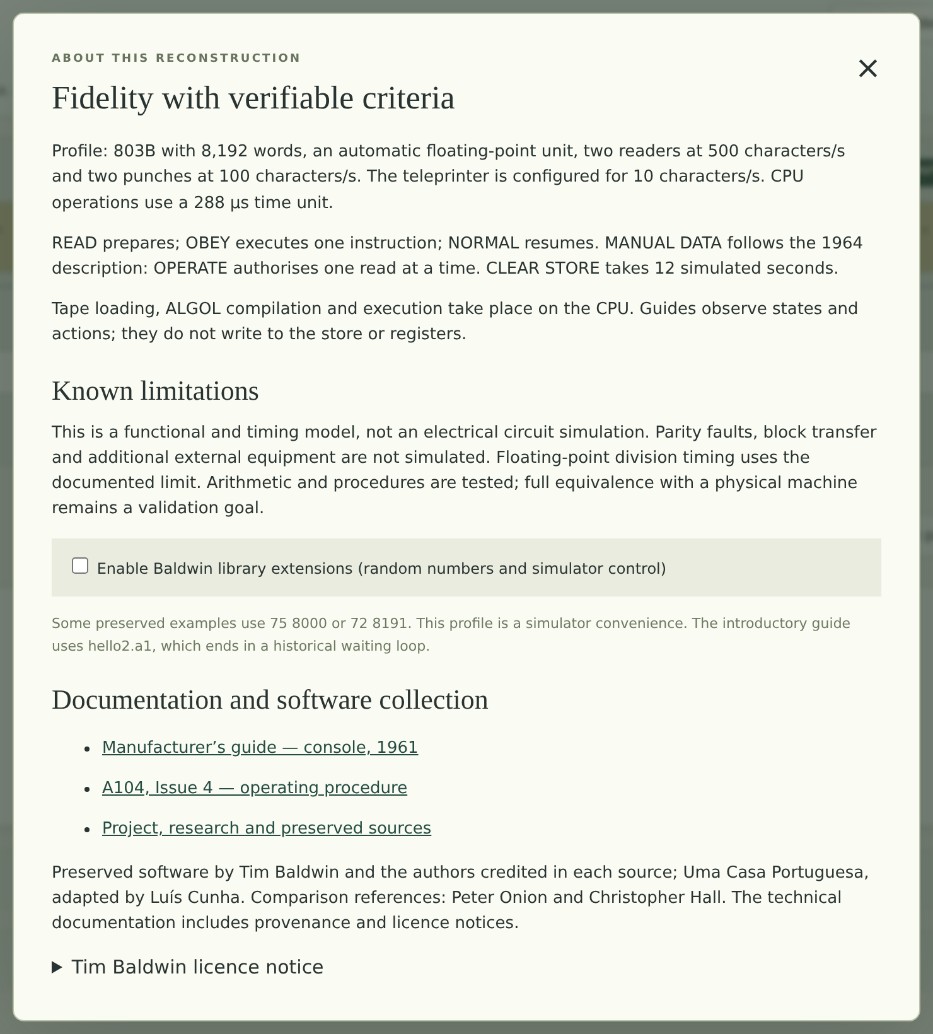
The project is best described as an operational reconstruction. It aims to be faithful in the areas that matter most to understanding the machine, and it states its limits inside the emulator itself. A “Sources, credits and fidelity” dialogue sets out the modelled profile, the known limitations and the provenance of the software. It is a functional and timing model, not an electrical simulation. Parity faults, block transfer and additional external equipment are not simulated. Floating-point division uses the documented timing limit. Full equivalence with a physical machine remains a validation goal. Peter Onion’s and Christopher Hall’s work are listed as comparison references, and Baldwin’s licence notice travels with the code. The emulator was developed and tested in Chromium-based browsers. Behaviour in other browsers, on small screens and on macOS still needs systematic testing. These are ordinary Web-development issues, but they illustrate a broader conservation problem: an emulator depends on a second, rapidly changing technical environment. Keeping the whole machine in one self-contained HTML file, with no external dependencies, is partly a response to that problem. The source code, bundled tape images, software folders and guides are available in the project’s public GitHub repository (www.ccsoc.org/git0.htm). A ready-to-run version of the earlier release remains at www.ccsoc.org/git1.htm. What remains to be done The immediate priorities are cross-browser behaviour, a console that adapts more gracefully to common screen sizes, and continued checking of the operating sequences against the original manuals, the established Java simulation and, ideally, the museum’s machine. The simulated clock makes that last comparison more meaningful than before: loading times, clearing times and program run times can now be measured and compared with the real 803B. The software library can be expanded, but provenance is more important than quantity. Each additional tape should ideally have a known origin, an explanation of its purpose and enough operating information for a new user to run it. The guide format makes it possible to attach that operating information to the program itself. There is also scope for recording demonstrations in which experienced Elliott operators explain not only which buttons to press, but why. The Portuguese side of the story is at an earlier stage. Locating documentation concerning the Banco Pinto de Magalhães installation, the LNEC machine, FEUP and the people who worked with them would add considerably to the project. Photographs, manuals, programs and personal recollections may still survive outside formal archives. Conclusion The Elliott 803B comes from a moment when computing was becoming both a practical service and an intellectual discipline. Its architecture, console and software make that transition unusually visible. Reconstructing it in a browser has been an attempt to preserve not only the result of computation, but the sequence of actions by which computation was made to happen. The new version takes that aim more seriously than the first. There are no shortcuts into the store. Time is simulated and accelerated openly, and the tutorials can confirm what the operator has done but never do it for them. A visitor can now switch on the machine, clear its store, load the ALGOL system from two tapes, compile and run Hoare’s quicksort, watch a plotter draw, inspect the store, and hear a 1960s computer play two Portuguese songs, one of which once signalled the end of a dictatorship. The project remains incomplete, and its debts to earlier preservation work are substantial. It is, I hope, a better beginning. About the author
|
Further searching on eBay revealed another interesting early 1953 advertisement for Ferranti, including a drawn image of the computer from another angle.
In conclusion, I still don’t know the publication details for the first image discovered on eBay (Fig. 2). The photograph is located on page 170 of a publication, in a section titled “CALCULATING MACHINE”, also covering Hollerith punched card sorters, the ENIAC, etc. The caption for the photograph in Fig. 2 reads as follows:
If anyone knows this publication or can identify either of the people in Fig. 2, do get in touch via . Acknowledgements: Thank you to Martin Campbell-Kelly and Dik Leatherdale for helpful suggestions based on an earlier draft. |
On Tuesday 29th September, The National Museum of Computing hosted the sixth Tony Sale Award, which, apart from the covid years, has been presented biennially by the BCS Computer Conservation Society since 2012.
For the first time, the five judges were unanimous in nominating David Lovett’s restoration of a Bendix G-15 computer. The restored computer is now on permanent display at the System Source Computer Museum in Maryland. Although the G-15 was an American machine, it had a pedigree that goes back to Alan Turing’s 1940s design of the ACE computer at the National Physical Laboratory. The architect of the G-15 was Harry Huskey (1916-2017). In 1947, Huskey spent a sabbatical year at the NPL where he worked on what became the Pilot ACE. Huskey then returned to the United States where he was employed by the US National Bureau of Standards. In 1953 he spent a year at Wayne State University in Detroit. There he designed the G-15 for the Bendix Corporation. The G-15 embodied many of the design ideas in the ACE design, particularly the use of optimum coding. Some 400 Bendix G-15s were eventually sold from 1963. The Award ceremony was opened by Martin Campbell-Kelly, the convenor of the judging panel. The Award was then presented by Nigel Sale, Tony’s son, who spoke eloquently about his father’s public and private lives. Next, David Lovett gave an entertaining lecture describing the history of the G-15 and the restoration process. The restoration was notable for the use of crowd-sourcing for problem solving and the posting of two dozen videos on YouTube, some of which attracted close to half-a-million views. This particular aspect of the project was noted by the judges as demonstrating a novel approach to outreach that attracted an international group of followers. The lecture concluded with a lively set of questions from the audience. |
Each of the compilers is presented as source code, and also as original binary code that can be emulated. Alongside this we present on-line copies of original documentation, enhanced with hot links as are the source code listings. We have 2 compilers for KDF9, and one for Elliott 903. The KDF9 Whetstone Algol was the only one to execute the code as shown on the front cover of Resurrection. KDF9’s other compiler, the optimising Kidsgrove Algol (a.k.a Kalgol) encountered what seems like a bug at the translate stage. The example needed modification before it was acceptable to Elliott 903 Algol. Clearly, not everyone found it a doddle to implement what was then a new programming language with novel features. Before awarding full marks to Whetstone Algol, it has to be admitted that the implementation does not compile into machine code, but an intermediate code which is then interpreted. As a result, it compiles the program rather quickly and then executes it rather slowly. What of Kidsgrove Algol? This delivers the rather terse FAIL 017/20 which the documentation explains as formal level statement without an actual statement including formal, with further explanation that this is in brick 20 (i.e. overlay number 20). After our successful rescue of Whetstone Algol as described in Resurrection 57 our initial dismay that Kidsgrove Algol had been lost was dispelled by news that Bill Waite in Colorado had a listing, which he then kindly scanned. His summary (www.ccsoc.org/hold7.htm ) included bad news about brick 20. Meanwhile Brian Wichmann’s painstaking photographing of material held in the Science Museum’s archive turned up a handwritten copy of brick 20. The late David Huxtable (one of the original authors of Kalgol) combined this with information lodged in his memory to produce the copy that we have today (www.ccsoc.org/hold3.htm. Not foolproof software engineering, but giving a good flavour of the original.
The proof of the pudding. Are the results correct?
Both Whetstone Algol and Elliott Algol get the same answers, but the inaccuracy is somewhat surprising until you realise how slowly the series converges. These experiments illustrate the state-of-the-art in implementation of programming languages in the 1960s. Algol 60 arrived on a scene in which FORTRAN was the sliced bread of the day, with some of the structure of assembly languages and variables tied to routines. The recursive nature of the block structure of Algol 60 presented a challenge to implementers, which tended to result in a trade-off between restrictions in the language in the interests of speed and validity checks at run-time with an inevitable slow down. Not only does the language permit recursive programs, but the language definition (BNF) is also recursive. Whetstone Algol’s determination to implement the whole language led to a lot of run-time checks. In the early days (pre-yacc) parsing Algol 60 was not seen as easy, and integer labels were often discarded. So what of Algol 60 no longer survives? I rather regret the loss of Jensen’s device which used call by name. It allowed
with an appropriate declaration of int(a, b, v, z), where a and b are called by value, and the other two by name. Algol 68 discarded the proceduring coercion which would have allowed it. In most modern programming languages declaration of procedures to perform the same algorithm is somewhat cumbersome. On the other hand I have no regrets about losing goto. Dikstra’s seminal letter in the March 1968 issue of Comm ACM provided the compelling evidence of its malign effects. I guess that you can tell it was a bad idea when you look at the rigmarole of Algol 60 switches and designational expressions. Despite Dikstra’s warning there is some reluctance to commit to the eradication of goto. It is a reserved word in Java although it is not part of the language. Jean Ichbiah reluctantly included it in Ada at the insistence of the US DoD. In the 1970s and 80s a focus on software correctness delivered strong typing with implementations designed to detect the maximum number of defects when a program was being compiled. After all, what is the distinction between an error detected at run-time and a bug? Have we come full circle with JavaScript and Python implemented by interpretation, and systems which call back to their suppliers to fix the bugs in the initial release? Note: The example published in the Algol 60 report contained a comment which did not make it to the front cover of Resurrection where space is tight. Here is that comment: euler computes the sum of fct(i) for i from zero up to infinity by means of a suitably refined euler transformation. The summation is stopped as soon as tim times in succession the absolute value of the terms of the transformed series are found to be less than eps. Hence, one should provide a function fct with one integer argument, an upper bound eps, and an integer tim. The output is the sum sum. euler is particularly efficient in the case of a slowly convergent or divergent alternating series. |
On the Nth day of Christmas my true-love sent to me: 12 Voids a-hipping 11 Firm coercions 10 Soft cohesions 9 United notions 8 Moid mode void 7 Structs a-straightening 6 Global ints 5 DERIVED MODES 4 Calls of proc 3 Trimscripts 2 Rows of row And a language orthogonally! In 1971, the British branch of the American Computer Sciences Corporation (CSC) had been involved in the project management and software development, under ICL/NRDC, of the real-time London Airport Cargo Expediting Scheme (LACES). During this period, CSC bid for a short study offered by the Civil Service Department (CSD) on the use of High-Level computer languages in Government Computing. CSC hoped that this would give them an opportunity to sniff out some lucrative government-related computer development opportunities. What CSD was really after was how to bury ALGOL 68 because RRE at Malvern had successfully developed a compiler for this newly specified, exotic, offspring of ALGOL. So, CSC was tasked with producing an impartial report showing how (un)suitable was ALGOL 68 for general government computing. CSC set up a 3-person team under the supervision of American Chet Brown, led by charismatic American Dick Gilinsky and 2 British programmers Wendy Gannicott and myself. Our ALGOL 68 team was located for a while at Malvern and had to understand the rather exotic terminology of this language. As Christmas 1971 approached our heads were spinning dealing with the terminology; we let off steam by producing an ALGOL 68 version of the 12 Days of Christmas, written primarily by Dick Gilinsky. |
How a quiet Thursday in 1951 became the birth of business computing On 29th November 1951, in a nondescript building above a tea warehouse in Cadby Hall, London, the world changed – quietly, elegantly, and with the unmistakable hum of valves warming to life. The machine was LEO I, the Lyons Electronic Office.
That morning, LEO I became the first computer in the world to run a real, routine, commercial business application, beating every American and British research laboratory to the milestone. It wasn’t a demonstration, a test, or a theoretical exercise. It was work. Real work. And it worked. Seventy five years later, the significance of that moment has only grown clearer. The story of LEO I is inseparable from the boldness of J.Lyons & Co., a catering and food manufacturing company with a flair for innovation. Lyons didn’t just want to automate; they wanted to reimagine how a business could operate. Inspired by the pioneering work at Cambridge on EDSAC, Lyons funded and extended the research, then built something entirely new:
The First Operational Run: 29th November 1951 The program that ran that day was deceptively simple:
But the achievement was profound. For the first time, a computer was not solving equations for scientists – it was running a business process end to end. The run was successful, both reliable and repeatable, and it marked the beginning of a new era. A World Record That Still Stands LEO I’s first operational run is recognised as:
Every payroll system, every stock control platform, every ERP suite, every cloud based business service – all trace their lineage back to that single run in 1951. The Human Story Behind the Machine LEO’s success was not just technical. It was cultural. The team – engineers, mathematicians, programmers, operators, and Lyons managers – created a new profession from scratch:
Their work set the standards for reliability, documentation, testing, and operational discipline that still underpin modern computing. A Legacy That Deserves Its Place in History Seventy five years on, LEO’s influence is everywhere:
Yet LEO’s story remains one of Britain’s most under celebrated technological triumphs – a moment when vision, engineering brilliance, and commercial daring aligned to create something truly world changing. Why the 75th Anniversary Matters Anniversaries are more than dates. They’re opportunities to reflect on what was achieved and what was made possible. On 29/30th November 1951, LEO I didn’t just run a program. It launched an industry. It reshaped the modern world. And it proved that innovation can come from the most unexpected places – even a tea shop company with a taste for progress. Seventy five years later, the achievement remains as astonishing as ever.
|
Members and others are welcome to attend CCS Seminars and these are also available via Zoom. London Seminar Programme
London meetings take place at the BCS – 25 Copthall Avenue Moorgate EC2R 7BP starting at 14:30. The venue is near the corner of Copthall Avenue and London Wall, a five minute walk from Moorgate Station and 10 from Bank. You should use the BCS event booking service to reserve a place at CCS London lectures. Go to www.computerconservationsociety.org/lecture.htm. The service must be used both for attendance in person and for remote attendance. For queries about London meetings please contact the CCS meetings secretary Roger Johnson at . Manchester Seminar Programme
Manchester meetings normally take place at The Manchester Metropolitan University, Chester Street, Manchester, M1 5GD – Room E0.05 in the John Dalton East Building starting at 18:00 (but see the description of specific lectures on the CCS website as building work is currently underway). Details are subject to change. Members wishing to attend any meeting are advised to check the events page on the Society website.
|
SIM : Demonstrations of the replica Small-Scale Experimental Machine at the Science and Industry Museum in Manchester are run every Wednesday, Thursday and Friday between 10:30 and 13:30. Admission is free. See www.scienceandindustrymuseum.org.uk/ for more details. The National Museum of Computing :See www.tnmoc.org/days-open for the opening hours schedule. Situated on the Bletchley Park campus, TNMoC covers the development of computing from the “rebuilt” Turing Bombe and Colossus codebreaking machines via the Harwell Dekatron (the world’s oldest working computer) to the present day. From ICL mainframes to hand-held computers. Please note that TNMoC is independent of Bletchley Park Trust and there is a separate admission charge. Visitors do not need to visit Bletchley Park Trust to visit TNMoC. See www.tnmoc.org for more details. Science Museum : There is an excellent display of computing and mathematics machines on the second floor. The Information Age gallery explores “Six Networks which Changed the World” and includes a CDC 6600 computer and its Russian equivalent the BESM-6 as well as Pilot ACE, arguably the world’s third oldest surviving computer. The Mathematics Gallery has the Elliott 401 and the Julius Totalisater, both of which were the subject of CCS projects in years past, and much else besides. Other galleries include displays ranging from ICT card-sorters to Cray supercomputers. Admission is free. See www.sciencemuseum.org.uk for more details. Bletchley Park: Exhibition of wartime code-breaking equipment and procedures plus tours of the wartime buildings. Go to www.bletchleypark.org.uk to check details of times, admission charges and special events. Other Museums : At www.computerconservationsociety.org/museums.htm can be found brief descriptions of various UK computing museums which may be of interest to members.
|
|
|||||||||||||||||||||||||||||||||||||||||||||||||||||||||||||||||||||||||||||||
The Computer Conservation Society (CCS) is a co-operative venture between BCS, The Chartered Institute for IT; the Science Museum of London; The National Museum of Computing (TNMoC); and the Science and Industry Museum (SIM) in Manchester. The CCS was constituted in September 1989 as a Specialist Group of the British Computer Society. It is thus covered by the Royal Charter and charitable status of BCS. The aims of the CCS are:
Membership is open to anyone interested in computer conservation and the history of computing. The CCS is funded and supported by voluntary subscriptions from members, a grant from BCS and by the free use of the facilities of our founders. Some charges may be made for publications and attendance at seminars and conferences. There are a number of active projects on specific computer restorations and early computer technologies and software. Younger people are especially encouraged to take part in order to achieve skills transfer. |