|
Old News
|
|
October 2026
|
The CCS Annual General Meeting will be held at 14:00 on Friday 23rd
October at the London offices of the BCS.
If you wish to attend on Zoom please login before 14:00.
It may not be possible to join after that time.
Those attending the lecture will be admitted shortly before 14:30 in time for
the start of the following lecture
Reports and other papers can be found
here.
|
|
March 2026
|
It is with sadness that we have to report the passing of Sir Tony Hoare who will perhaps be known
to many members as a name most associated with the early days of Algol 60 although there was
much more to him than that.
Resurrection 111 includes an obituary written by a close colleague.
|
|
January 2026
|
The IEEE has recognised the invention of Manchester code in 1948 as a Milestone technical
achievement and the Milestone will be awarded at a ceremony at The University of Manchester
on the afternoon of 13th April 2026.
There will be technical talks describing the invention and its impact as well as the formal
handover of the Milestone plaque.
Manchester code was invented for the storage of data in the magnetic drum store of the
Manchester Mark I computer.
It became a standard for computer magnetic tapes and floppy disks, and was used in
digital communications including the Voyager 1 and 2 spacecraft and early Ethernet networks.
It found wide use in Radio Frequency Identification (RFID) tags, many control network
standards and domestic remote controllers found in millions of homes across the world.
For more information about the event and to register please go to
ccsoc.org/man0.htm.
In-person attendance is encouraged and is free of charge, however tickets are needed and
obtainable via the link above.
The event will also be publicly live streamed (no advance booking required) at
ccsoc.org/man1.htm.
|
|
December 2025
|
Since 2005, the Society has run a scheme whereby members of the Computer Conservation Society
who are NOT members of BCS and who are thus not elegible for paper copies of Resurrection
may continue to receive paper copies on a subscription basis in the sum of £10 for four
issues.
There has been a low and declining takeup of this offer and the error rate in the processing
of subscriptions has caused the Society to rethink these arrangements.
With regret therefore, the Society has decided to terminate the subscription scheme.
Resurrection 110 will be the last edition available on sbscription.
Kindly note, however, that the paper copies available to some former BCS members will continue
to be supplied.
The revised arrangements are described here.
|
|
November 2025
|
On Saturday 15th of November the BBC broadcast an edition of their
long-running series Desert Island Discs when the guest was
Sir Tim Berners-Lee.
There was much discussion of his creation of the World Wide Web but there was also
talk of the lives of his parents, Conway and Mary Lee Berners-Lee
both of whom will be well-known to many CCS members as computing pioneers at Ferranti
in the 1950s.
Now available from BBC Sounds at
www.bbc.co.uk/sounds/play/m002m96c
.
|
| September 2025 |
We are distressed to have to report the passing of a stalwart of the Society,
Professor Simon Lavington FBCS.
Simon graduated in Electrical Engineering at Manchester University in 1962.
He gained a PhD for his pioneering research in automatic speech recognition
utilising the Atlas computer.
Moving to the University of Essex in 1986, as Professor of Computer Science,
Simon led the Intelligent File Store (IFS) project, which was granted a BCS
Silver Medal for Technical Achievement.
Following retirement in July 2002 he researched and wrote about computer history,
his passion since 1970.
He wrote numerous journal articles and books on the history of computing with a focus
on early British computers during the period 1945 to 1970
Simon was an energetic researcher and above all, a good friend who will be missed by many
Roland Ibbett’s excellent Guardian obituary can be found at
www.theguardian.com/education/2025/nov/28/simon-lavington-obituary
and Resurrection 110 will carry another by Martin Campbell-Kelly.
|
|
| August 2025 |
It is with much sadness that we have heard of the passing of Dame Stephanie
(“Steve”) Shirley, a significant figure in the IT industry in the UK.
Founding Freelance Programmers Ltd – an organisation of largely female,
home-based programmers, Dame Stephanie did more than anybody to sweep away the male
domination of the industry in the ’60s and ’70s.
We can do no better than refer readers to Georgina Ferry’s excellent Guardian obituary
www.ccsoc.org/fer0.htm.
|
| July 2025 |
CCS Visit to Edinburgh National Museum of Scotland Collections Centre
We have arranged a tour of the National Museums Collection Centre in Edinburgh,
where we to hope to view a rather interesting collection of vintage computers
in their reserve collection, including a Ferranti Mark 1*, A Ferranti Mercury
and the remains of the Chilton Atlas 1.
There may be a small charge, depending on the number of us participating.
We will meet up for the tour at 13:00 on Tuesday 2nd September, at the
Collection Centre at 242 W Granton Rd, Edinburgh EH5 1JA.
We would like to get together for dinner at Howies, Victoria Street in the Old Town
at 19:00 on the previous evening, Monday 1st September.
Hotel and travel arrangements are, of course, the individual responsibility of participants.
There are several hotels in the vicinity of Princes Street, including the Ibis
“South Bridge” and the Premier Inn at Princes Street.
Do join us, and bring partners, friends and relations.
It will be fun!
As usual, Dan Hayton will be our organiser.
You should contact him at so we know
you’re coming and so that he can confirm numbers for the tour,
and keep you in touch about any arrangements.
|
| February 2025 |
It is with much sadness that we have to report the passings of two distinguished pioneers
from the very earliest days of computing
G.E. (Tommy) Thomas passed away in July last year in Australia.
He was the last surviving member of the team which created the Manchester Mark 1 computer.
Based on the well-known Small Scale Experimental Machine, but adding several important and long-lasting
features, the Manchester Mark 1 in turn, became the basis for the Ferranti Mark 1 the world’s
first commercially produced computer.
Dr Raymond (Dickie) Bird was best known for his heroic achievement of creating a properly engineered
version of Andrew Booth’s APEC computer which Booth had built in a barn in Fenny Compton.
Dr Bird’s version was brought to market by his employer, the British Tabulating Machine company
as the HEC (Hollerith Electronic Computer), later renamed the ICT 1201 which, for a while became the
UK’s best selling computer.
Resurrection 108 carries longer obituaries for both these important
contributors to our art.
|
| September 2024 |

Congratulations to Professor Simon Lavington late of the Universities of Manchester and Essex
who has been awarded an Honorary Fellowship by the National Museum of Computing.
The award recognises the huge contribution that he has made to the study of the history
of the UK computer industry.
In particular for the publication of several books documenting the stories of some of the UK
computer companies which are, alas, no longer with us but whose influence persists to this day.
The CCS and TNMoC are both fortunate in being associated with such luminaries as Professor Lavington .
|
| August 2024 |

Our hearty congratulations to Roger Johnson who, after many years of volunteering
in senior roles for the BCS has been awarded an Hororary BCS Fellowship.
Those of us who have had the pleasure of working with him in the Computer Conservation Society
have long since appreciated his tireless dedication to the smooth running of the Society
both as a former chair of the Society and over a long period as London Meetings Secretary.
But we don’t know the half of it, for his contribution to our parent body, the BCS
goes back much further including his year as BCS President.
Well done Roger.
Well done BCS.
What took you so long?
|
| May 2024 |
It is with much sadness that we have to report the passing of two members of the CCS committee.
Peter Short was the represenative of the IBM Hursley Museum and editor of its website and newsletter.
His reports were always timely, always interesting and always conveyed the enthusiasm he had
for IBM and all its achievements.
A tribute will be in the forthcoming edition of Resurrection.
Aneesa Riffat was the Senior Curator and Collections Manager at The National Museum of Computing
and was responsible for liaison with us at the Computer Conservation Society.
Although she had not been in post for very long, it was evident that her enthusiasm was a huge asset.
Ever helpful and ever quick to respond, her death was unexpected.
We had exchanged emails on the day of her passing.
Both will be much missed.
|
| February 2024 |
The Computer Conservation Society (CCS) arranges visits to Computer Museums in Europe.
We have previously enjoyed visits to Belgium, Italy, and a number in Germany.
This year the plan is to visit Musée Bolo, Lausanne, Switzerland
(www.museebolo.ch/en/)
on the site of the École Polytechnique Fédérale de Lausanne (EPFL).
This campus is a 25-minute journey west of central Lausanne.
The address is Bâtiment INF, Station 14 1015 Lausanne Switzerland.
We warmly welcome those of you and partners/guests who would like to join in.
It is always a convivial occasion.
The visit is scheduled for the afternoon of Friday 26th April 2024 at
17:00 – Visit to Musée Bolo followed by a meal at Gina Restaurante
also at EPFL
(www.gina-ristorante.ch).
We are also invited to visit the reserve collection in central Lausanne.
There will be the opportunity for other activities on the Saturday, see below for a suggestion.
NB The museum is closed at the weekend.
Hotel and travel arrangements are participants’ individual responsibility.
Everyone makes their own arrangements and we arrange meeting points with each other when we are there.
Suggestions for hotels are:
There are numbers of other hotels in the area and there are offers on the internet for city breaks.
It has also been suggested that it might be possible to arrange a “side visit”
on Saturday to supplement the museum day.
There is a boat scheduled to leave Lausanne at 09:00 am (direction Villeneuve).
It will sail past the UNESCO World Heritage site – Lavaux Vineyards.
It will call at Vevey and Montreux and the Chateau de Chillon (about 2 hours),
We could leave the boat at Chillon to visit the castle, and then return by train to Lausanne
(probably around 17:00).
Shops are open till 19:00, & the Cathedral is worth a visit.
Ticket prices, in Swiss francs:
|
|
Boat Lausanne to Chillon 2nd class ₣30.
|
|
|
Mobilis day pass for 8 zones ₣31 –
(24 hours use of all trains, buses and Lausanne Metro between Lausanne Centre or EPFL and Chillon).
|
|
|
Chillon castle entrance ₣15.– (12.50 for seniors)
|
There is also a possibility of a wine tasting at the chateau after the tour – ₣31 –
per person minimum 10 people (this may include the guided tour fee? i.e. tour plus wine tasting)
The Mobilis pass would allow for people to stop at Vevey or Montreux on the way back and continue
later with the pass.
As usual, Dan Hayton is our organiser.
Please contact him at so we know you’re coming
and whether you are interested
in the boat trip, and so that we can tell the museum and the restaurant the numbers.
|
| October 2023 |
The Society has initiated a new award called the CCS DISTINGUISHED SERVICE AWARD
to acknowledge exceptional service to the Society.
At our London meeting on the 12th of October the first two awards were presented to
Roger Johnson and Dik Leatherdale .
|
| September 2023 |
Our good friends at The National Museum of Computing have arranged a series of lectures and other
events.
We are pleased to have been asked to publicise their program alongside our own list of forthcoming events
Go to
www.computerconservationsociety.org/lectures/current/lecture.htm
and scroll down for the current programme.
|
| August 2023 |
Wuthering Bytes is back!
Following a three year hiatus, the annual event which is Wuthering Bytes
returns to Hebden Bridge in West Yourkshire from the 25th of August to the 3rd
of September.
Go to wutheringbytes.com
for more information and note that Kevin Murrell and Martin Campbell-Kelly
are both appearing.
Should be good.
|
| June 2023 |
|
| April 2023 |
Rachel Boon, our representative from the Science Museum is about to go on maternity leave.
We wish her the very best and hope to see her when she returns.
Meanwhile, please welcome Hattie LLoyd from Manchester’s Science and Industry Museum who will be covering for her.
|
| January 2023 |
In 2014 the Society organised a group visit to the Heinz Nixdorf Museumsforum in
Paderborn, Germany
www.hnf.de/en/home.html
Such was the success of the trip that we have repeated it each spring,
visiting computer history museums throughout Europe.
In 2023, we are returning to our friends in Paderborn to see the progress that has
been made and to experience, once again, the world's largest computer museum.
The centrepiece of our visit will be our day at the Museum itself on Saturday 15th April.
The plan is to foregather the previous evening for dinner in one of the excellent local
restaurants (everything you may have heard about German cuisine is wrong– it’s great)
and, in all likelihood, this will be repeated the following evening.
All CCS and TNMoC members and their guests are warmly invited.
Do join us. It will be fun!
Our previous hotel, the Arosa Hotel in the Westernmauer, a Best Western hotel,
is our planned base for the weekend.
Hotel and travel arrangements are, of course, the individual responsibility of participants.
There is an airport at Paderborn, but it is quite a long way out and flights from the UK tend
to be via Munich!
Flying to Dusseldorf or Dortmund and thence by rail to Paderborn would appear to be a better bet.
Or perhaps take to the rails all the way from St Pancras.
A few of us are planning an excursion by rail on Sunday 16th to (relatively) nearby
Wuppertal to experience the well-known “Danglebahn”
(more properly the Schwebebahn – a unique suspended monorail railway)
and you are welcome to join us.
As usual, Dan Hayton will be our organiser. You should contact him at
so we know you’re coming.
|
| January 2023 |
The answers to the Annual Christmas quiz run by the CCS North-West Branch can be found at
computerconservationsociety.org/quiz/2022 answers.pdf
.
|
| October 2022 |
It is with much sadness that we have to report the recent passing of Kathleen Booth
in September at the age of a little over 100 years. Roger Johnson writes –
She must be one of the last of the women true pioneers starting work at Birkbeck in 1946
with Andrew (Donald) Booth who she subsequently married.
She had a PhD in Mathematics from Kings College London.
Her written legacy is rather small but it is clear that she was part of a real team with Donald.
Her role as I assess it was firstly to write software to test the hardware that he built
(although it is clear she also helped with the electronics) and subsequently went on to
build innovative applications in areas including natural language translation and also early ideas on AI.
She wrote one book published in 1958 on the programming of their APERC, HEC2 and MAC computers.
|
| April 2022 |
In view of the torrent of dreadful news from Ukraine it seems unimportant
but nevertheless we have received this report from Mariupol.
“Russian attacks on the Ukrainian city of Mariupol have destroyed an important computer museum
filled with Soviet-era artifacts-Russian forces essentially destroyed their own history.
Other cultural institutions remain vulnerable, including the Software & Computer Museum.”
|
| April 2022 |
Hear an inside account of the Cray-1 supercomputer and the evolution of Cray machines,
celebrating the 50th anniversary of Cray Research.
Arranged by our colleagues at the National Museum at Bletchley Park for the 6th
of April there is a modest charge for this online event.
Go to
the TNMoC website
for more information and a link to the event booking page.
|
| April 2022 |
Bookings are now being accepted from CCS members and other “insiders”
for the IEEE “Milestone Award” events described below under
“February 2022”.
Go to
www.eventbrite.co.uk/e/ieee-milestone-awards-the-baby-and-atlas-computers-tickets-261168240237
to book.
Bookings will open to the general public on the 21st of May.
You’ll see that there is no cost and that you can register to attend in person
or online.
If online, then a link will be sent out a few days before the event.
We look forward to your registration for an interesting event that is being part-sponsored by the CCS.
|
| April 2022 |
Members may be interested in an upcoming Newcomen Society lecture by Steve Furber
on the history of the ARM microprocessor which lies at the centre
of almost every mobile ’phone in the world.
In-person or Zoom attendance is available.
Go to
www.eventbrite.co.uk/e/the-call-to-arms-dickinson-lecture-by-steve-furber-tickets-310569771547
to book.
|
| February 2022 |
The IEEE History Committee has approved two IEEE Milestone Awards for major developments
in computer history which took place in Manchester.
Bronze plaques marking these awards will be unveiled in Manchester on the afternoon
of 21st June 2022, the 74th anniversary of the first program
run by the Manchester Baby computer.
There will also be a morning event in the Manchester Museum of Science and Industry
at which the replica Baby computer will be demonstrated by a team of volunteers
and there will be a display of material from the Ferranti archives.
The two awards are for the
Manchester University “Baby” Computer and its Derivatives, 1948-1951
and the
Atlas Computer and the Invention of Virtual Memory 1957-1962.
After the plaque unveilings there will be talks describing these two developments
and the reasons why they are considered historically important.
A provisional schedule of the event is
here.
Registration information will be circulated shortly.
Meanwhile, please reserve the 21st June in your diary.
|
| February 2022 |
The first six of the IEEE Region 8 HISTELCON conferences have their presented
papers in the IEEE Xplore database.
Until recently, only the titles and abstracts were open to view by all, to see
the full papers required access permission to IEEE Xplore,
which is extremely costly, even for IEEE members.
Now, after some lengthy negotiations the full papers have been made
freely available to all persons, forever.
These are the conferences involved:
1. 2008: Paris, France, September 11-12
2. 2010: Madrid, Spain, November 3-5
3. 2012: Pavia, Italy, September 5-8
4. 2015: Tel Aviv, Israel, August 16-21
5. 2017: Kobe, Japan, August 7-8
6. 2019: Glasgow, Scotland, September 18-19
The 7th HISTELCON was held in Moscow last year (18-20 August 2021) -
entirely by ZOOM.
The papers are still being prepared for submission to IEEE Xplore,
and initially the full papers will be available only for payment.
However, negotiations to make them free to all will be attempted.
The 8th HISTELCON is planned for Florence,Italy, probably 8-9 September 2023.
|
| January 2022 |
The answers to the annual Christmas Quiz
(quiz/2021 questions.pdf)
compiled by the CCS North-West Branch are available at
quiz/2021 answers.pdf.
|
| December 2021 |
The Society regrets to announce that our lecture on Singer System 10
scheduled for the 20th of January 2022 has been cancelled as the speaker has
had to withdraw.
|
| October 2021 |
Our good friends at the Heinz Nixdorf Computer Museum in Padeborn tell us that they are due
to receive an “IEEE Special Citation in History” plaque to recognise the achievements
of the museum in teaching a broad audience about the history of computers.
The award will take place take place on the 29st of October at 18:00 (BST)
and co-incides with their 25th anniversary.
The event will be live streamed in German and English at
www.hnf.de/veranstaltungen/events/jubilaeum-live.html
.
|
| May 2021 |
The Computer Conservations Society has, at last, entered the world of social media
and thus the 21st century.
We now have a Facebook group which you will find in the left margin of this page.
|
| May 2021 |
Our friend Sir Dermot Turing will deliver an online lecture under the auspices of
Tne National Archive upon the subject of his esteemed uncle Alan Turing.
Amongst other concerns he will address is the rather surprising question
“Was Alan Turing actually much of a codebreaker?”.
The vehicle in this case will be Microsoft Teams.
Details and booking information can be found at
https://www.eventbrite.co.uk/e/reflections-of-alan-turing-tickets-152682917717?aff=wowp
.
|
| May 2021 |
Just arrived (albeit somewhat behind schedule as befits any IT project)
the big Manchester Christmas Quiz for 2018, 2019 and 2020.
If you missed it before, it’s here
|
March 2021 |
An Introduction to Silicon Valley’s Computer History Museum
Your attention is drawn to a online presentation, organised by BCS The Chartered Institute for IT
on Tuesday 13th April from 19:00 to 20:30
Given by Dag Spicer, Senior Curator, Computer History Museum,
the presentation will provide a brief background to the Computer History Museum.
The audience will be shown how they can make a virtual visit to the museum
from anywhere in the world with an internet connection.
The speaker will present some of the highlights to be found in
the museum and the plans for the future.
|
| November 2020 |
Tony Sale Award 2021
It was with much regret that we had to cancel arrangements for the Tony Sale Award this year,
due to the worldwide coronavirus pandemic.
The Computer Conservation Society has now taken the decision to leave this for an
additional year to ensure that any projects which might be eligible will have sufficient
time to catch up, hopefully when the virus allows work to continue, as well
as providing time to seek a new sponsor for the Award.
It is therefore hoped to publish the invitation in January 2022
with the aim of making an Award in November 2022.
Peta Walmisley
|
| August 2020 |
COVID-19
In view of the present Covid-19 emergency the Society has decided that it will not be possible
to hold our next few lectures in our usual “face-to-face” fashion.
For the next few months, until the situation eases, lectures will be delivered
over the Internet using ZOOM.
In the absence of geographic constraints, the program will be a joint one.
It will be necessary to pre-register your intention to attend so that we can email you the information
you will need to attend.
|
| November 2020 |
The Flexipede
We are pleased to draw your attention to a lecture (on Zoom) organised by
Rutherford Appleton Labs lecture entitled
“Following Flexipede's Footsteps: Software Archaeology and Cybernetic Serendipity”.
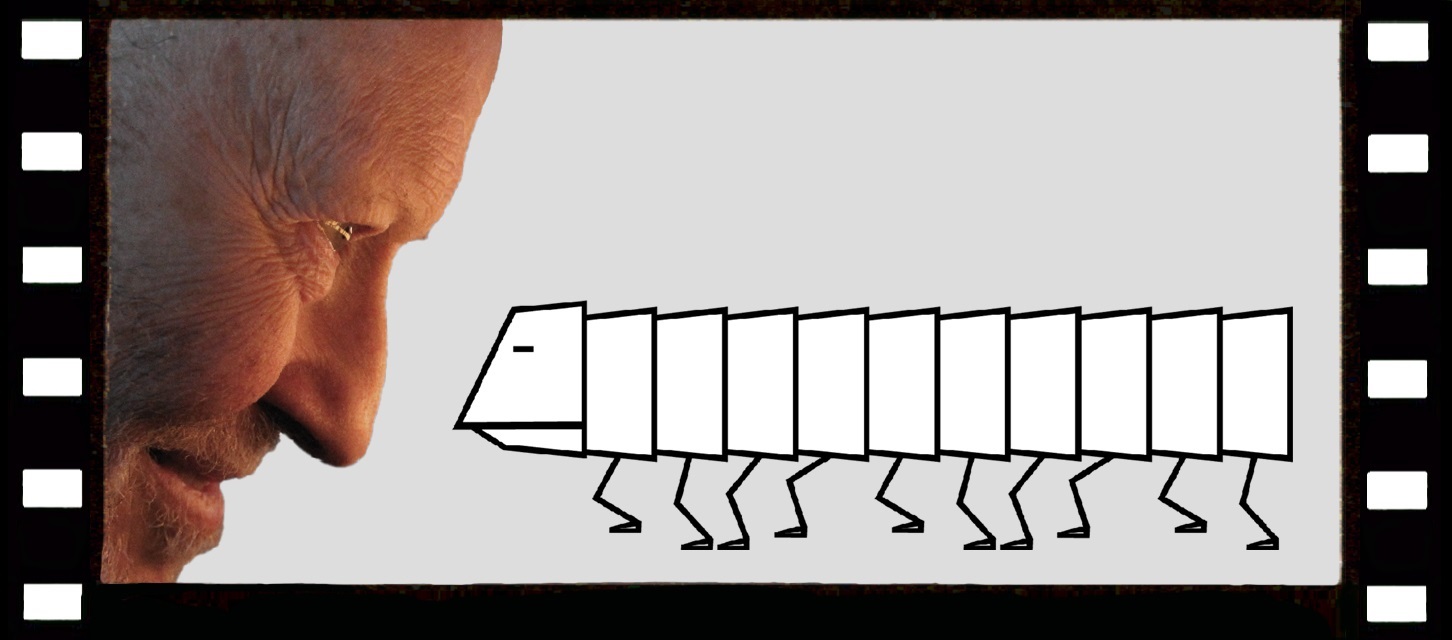
In 1967, Tony Pritchett used the Ferranti Atlas computer at London University,
a nuclear fusion laboratory, and a squeaky office chair to create a short
film featuring what is arguably the world's first computer-animated character.
The following year, all two minutes of this whimsical little film were premiered
at Cybernetic Serendipity — a flagship exhibition of art, music, mathematics
and sculpture which blurred the boundaries between arts and sciences,
and changed the world’s view of computers as more than just automatic
calculating machines.
Sadly, Tony is no longer with us, but this talk sets the scene for the making
of The Flexipede and its connection with the Atlas Computer Laboratory.
It illustrates how Kate got to know Tony and learn more about his work,
and how a chance remark led to the use of three home PCs,
another research laboratory, and a lot of coffee to scan thousands of punched cards.
Finally, the talk will give some insights into techniques Tony used in his program,
and reveal whether we really have rediscovered the Flexipede.
Join Kate Sullivan, Professor David Duce and Dr Victoria Marshall with Professor Bob Hopgood
via Zoom at 14:00 on Thursday 26 November at
ukri.zoom.us/j/95732365698
|
| Aptil 2020 |
Tony Sale Award
The CCS has regretfully made a decision to cancel the Tony Sale Award 2020
because of the coronavirus situation, which is affecting many countries
around the world.
We hope to be able to run the Award during 2021.
|
| March 2020 |
COVID-19
In view of the COVID-19 pandemic the remaining events of the 2019-20
season have been postponed.
Events from September onwards remain but will be reviewed nearer the time.
|
| March 2020 |
CCS visit to the Heinz Nixdorf Museumsforum Cancelled
We have heard that the Heinz Nixdorf Museum in Paderborn is now closed
“until further notice” because of the COVID-19 pandemic.
Obviously our planned visit there in April cannot now take place.
We hope to be able to re-arrange the visit at a later date, though when that might
be is uncertain.
Please accept our apologies for the inconvenience and for any unrecoverable expenditure
which you may already have made.
We do, however, suggest cancelling hotel reservations and travel arrangements.
|
| March 2020 |
Margaret Sale
It is with much sadness that we have learned of the passing of a valued friend of the CCS
– Margaret Sale.
It would be tempting to describe Margaret as the widow of the late Tony Sale, the co-founder of our society
– but she was much more than that.
Margaret it was who campained to save Bletchley Park for the nation and. as a Fellow of the
National Museum of Computing continued actively to support the work there until her
relatively recent ill-health prevented her involvement on its former scale.
Margaret was a charasmatic, “larger than life” figure who will be much missed.
|
| January 2020 |
CCS visit to the Heinz Nixdorf Museumsforum
In 2014 the Society organised a group visit to the Heinz Nixdorf Museumsforum
in Paderborn, Germany
www.hnf.de/en/home.html
Such was the success of this event that we have repeated it each spring,
visiting computer history museums throughout Europe.
In 2020, we are returning to our friends in Paderborn to see the
progress that has been made and to experience, once again,
the world’s largest computer museum.
The centrepiece of our visit will be our day at the Museum itself on
Saturday 18th April.
The plan is to foregather the previous evening for dinner in one of the excellent local
restaurants (everything you may have heard about German cuisine is wrong - it’s great)
and, in all likelihood, this will be repeated the following evening.
All CCS and TNMoC members and their guests are warmly invited.
Do join us.
It will be fun!
Hotel and travel arrangements are, of course, the responsibility of participants.
Our previous hotel,
the Arosa Hotel
in the Westernmauer is our planned base for the weekend.
There is an airport at Paderborn, but it is quite a long way out and flights
from the UK tend to be via Munich!
Flying to Dusseldorf or Dortmund and thence by rail to Paderborn
would appear to be a better bet.
Or perhaps take to the rails all the way from St Pancras.
A few of us are planning an excursion by rail on Sunday 19th
to (relatively) nearby Wuppertal to experience the well-known “Danglebahn”
(more properly the
Schwebebahn
– a unique suspended monorail railway)
and you are welcome to join us, of course.
As usual, Dan Hayton will be our organiser.
You should contact him at
so we know you’re coming.
Sadly this trip has had to be cancelled because of the COVID-19 pandemic.
|
| January 2020 |
Annual Appeal for Donations
New Year greetings to CCS members and indeed to any casual readers of this website.
As is our custom at this time of year, the Society is making an appeal for donations
(in lieu of membership fees) so that we can continue to support our computer
restoration projects and other related activities.
Our appeals letter can be found here.
The Society is grateful to everybody who is able support our work in this way.
Thank you.
|
| January 2020 |
Y2K Article
Our friend, Prof. Martyn Thomas has written an interesting article in
The Guardian giving an historical perspective on the Y2K problem of 20 years ago.
Definitely worth a few minutes of your time.
Read it here.
|
| January 2020 |
Access to the Latest Resurrection
If you bookmark www.computerconservationsociety.org/res.htm
in your browser, it should always redirect you to the latest
edition of Resurrection.
Hat tip to David Holdsworth for his suggestion.
|
| December 2019 |
Changes to London Event Booking
From January 2020 there has been a small change to the BCS/EventBright
system for booking places at our London seminars.
Following any of the “Book” links for the early 2020
events will take you to a page where you will be offered the
opportunity to book all or any of the events from January
to May 2020, all in once place, rather than booking each event separately.
Many thanks to the CCS member who made this suggestion.
|
| October 2019 |
CCS Annual General Meeting
The AGM of the Society will be at 14:00 on the 17th of
October before our regular meeting.
Venue as below.
Members are encouraged to attend.
The agenda and other papers can be found
here.
|
| July 2019 |
New Venue for the CCS London Events
Future CCS London meetings will be at the new BCS location at
25 Copthall Avenue, Moorgate EC2R 7BP.
The venue is on the corner of Copthall Avenue and London Wall,
a five minute walk from Bank Station (connection from Waterloo)
and three from Moorgate
(connections from all the other major London rail terminii except Marylebone)
The new venue is a ground floor, brand new refurbished space with an onsite café.
|
|
|
New £50 Bank Notes
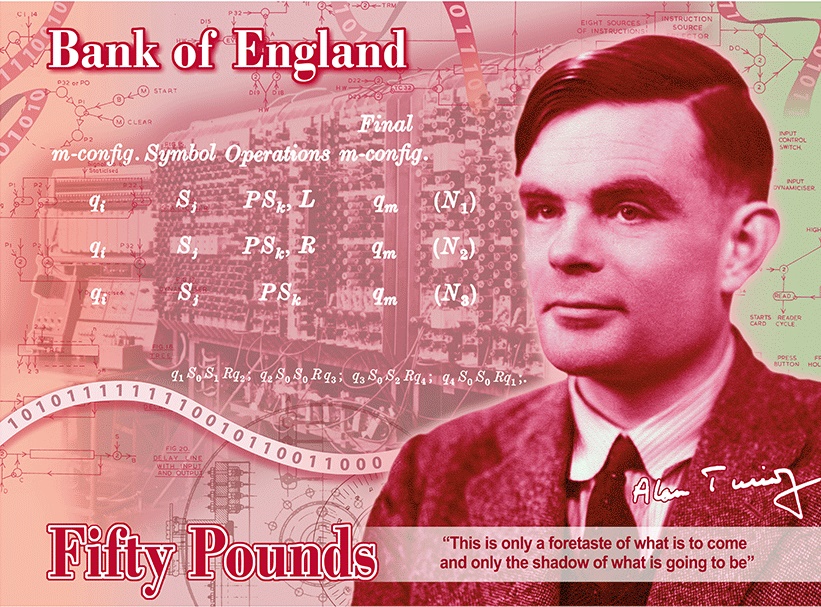 In Resurrection 85 we wondered whether Alan Turing might one day appear
as the face of the new £20 bank note.
Such is the power and influence of our journal that Turing has NOT been chosen
for the £20 note, but has been elevated to the £50!
How many of us will ever get to hold one is of course, another matter.
In Resurrection 85 we wondered whether Alan Turing might one day appear
as the face of the new £20 bank note.
Such is the power and influence of our journal that Turing has NOT been chosen
for the £20 note, but has been elevated to the £50!
How many of us will ever get to hold one is of course, another matter.
|
IEEE HISTEL Conference at Strathclyde University in September
The University of Strathclyde is hosting the 2019 IEEE History of
Technology conference on the 18th and 19th
of September.
Supported by the CCS, the conference will include a broad spectrum
material with a primary theme of “Historic Computers”.
Of particular interest to CCS members are a presention on
early Ferranti computers by our own Simon Lavington and a
talk on Harry Huskey and the Bendix G-15.
There is much else besides to spark interest.
Details at https://www.histelcon2019.org/.
|
| June 2019 |
OBE for Frank Land of LEO fame
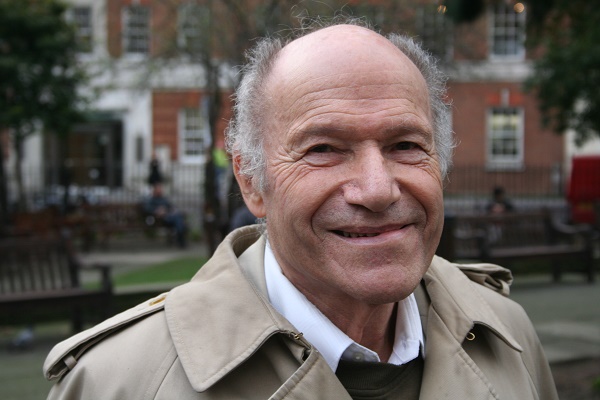
Our good friend Frank Land has been awarded an OBE in the Queen’s Birthday Honours List.
The award is for services to the information systems industry.
Frank was a leading member of the small team that developed the world’s
first business computer, a wholly British achievement.
He then went on to become the UK’s first professor of information
systems and to have an outstanding career in university education.
At the age of 90, Land, born Landsberger in Berlin, who came to England
as a young boy fleeing Nazi Germany, expressed his delight at receiving
the award which he modestly sees as “a sign of recognition
of the LEO contribution to information systems.”
Congratulations Frank!
|
| April 2019 |
CCS Visit to the Computer Museum NAM-IP in Namur
A party of CCS members (and partners) Travelled to Namur in Belgium to visit the
excellent computer museum there.
Although the museum is tucked away in the outskirts of the city and looks somewhat
unprepossessing from the outside, once inside it is a really well-presented
collection of artefacts which have been put together from four previous collections
in the country.
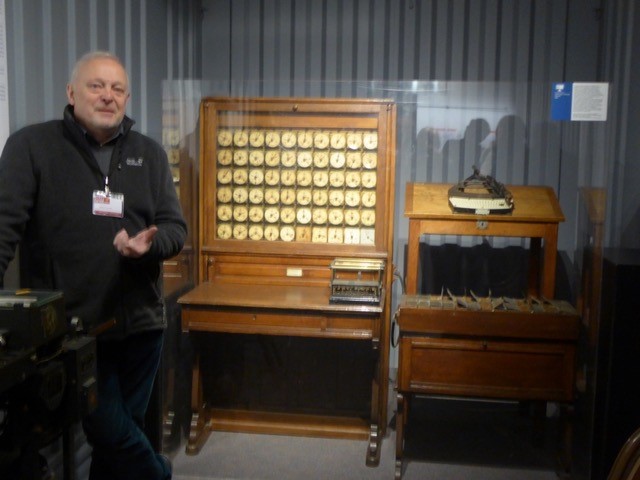
The undoubted star exhibit is an 1882 original Hollerith machine which counts holes in punched
cards and displays the results on a set of dials above.
Brought to Belgium by IBM for he 1958 World’s Fair (EXPO 58) it was unaccountably
left behind and is now a designated national treasure being one of only four such machines remaining.
Our photograph above shows it with one of our hosts Ward Desmet, President of the NAM-IP Association.
But there is much else to be seen.
From the Bull and Burroughs companies come two collections of computers and, of course, IBM is
also well represented.
From punched card equipment and mechanical calculators to much more modern PCs the story of the
IT industry is well-illustrated,
Our hosts were generous with their time and hospitality, a process much assisted by Belgium’s
well-deserved reputation for excellence in both cuisine and beer a great deal of which
was consumed with enthusiasm (you would expect no less).
Our heartfelt thanks to our hosts Ward Desmet and Ferdinand Poswick.
|
| February 2019 |
BCS Honours Doron Swade
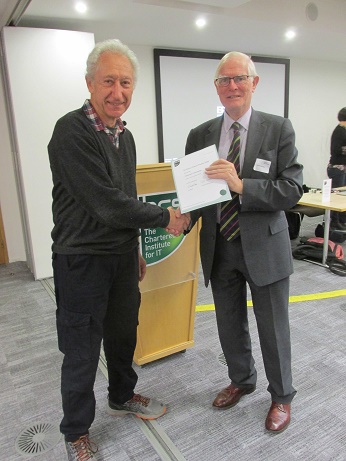
At our February London meeting, CCS co-founder Doron Swade was presented with
the award of a BCS Hororary Fellowship for his outstanding achievements in the
field of the history of computing not the least of which has been his
tireless support of the Society since its inception in 1989.
BCS Honorary Fellowships are not lightly given.
BCS rules specify that “Nominees will have made an outstanding contribution
to the charitable objects of the BCS over an extended period of time.”
They further go on to state “... it is not expected that there
will be more than 2 Honorary Fellows elected in any one year.”
More in the summer edition of Resurrection.
|
| December 2018 |
CCS Annual Visit to Computer Museum
Will be to the
Computer Museum NAM-IP
in Namur, Belgium.
A date of Saturday the 13th of April is now definite.
The last four years have taken us to computer museums Paderborn, Berlin, Munich and Pisa,
each with much to show us, each great fun in good company.
Our visit to Namur promises to be no less fascinating and enjoyable.
Contact Dan Hayton at
by mid January so that he can assess the size of the party and
construct logistics to match.
|
| December 2018 |
Data Privacy Statement
We have published a statement of the Society’s Data Privacy
Policy here.
|
| November 2018 |
Tony Sale Award Won by TechWorks!
The 2018 Tony Sale Award for computer conservation has been won by a
project to restore three generations of flight simulators.
The Center for Technology and Innovation (Techworks!) in Binghamton, New York, USA,
has brought back to life a Second World War analogue flight simulator,
a 1960s solid-state hardware version and a digital simulator from the 1980s.
The public has been able to experience each of the three ‘Pilot Makers’
to grasp the pace of innovation and development of simulation technology.
Please go to
www.sale-award.org
to read the full story.
|
| October 2018 |
Leo Society and Centre for Computing History Awarded Lottery Grant
Our friends the LEO Society are custodians of a number of artefacts and a great deal
of written material related to LEO Computers Ltd.
Like the Computer Conservation Society they have no premises in which the
material can be stored and displayed and some of it is “at risk”
as the individual custodians get older.
In concert with the Centre for Computing History in Cambridge they have appied for
and received a grant of £101,000 to develop plans for a facility in which
their archive can be secured.
If these plans are successful, a full development grant of £265,000 may follow.
Our hearty congratulations to both parties.
Obviously we wish them well in moving forward to realise their vision in full.
A full press release can be found at
www.leo-computers.org.uk/images/HLFApprovedLEOPressRelease.pdf.
|
| September 2018 |
Le CCS Français?
We have heard from our friends in France that there will be monthly meetings
in Paris on IT History, starting on Thursday 4th October 2018 with
a presentation on A French history of digital animation –
Une histoire française de l’animation numérique
A l’occasion de la sortie de son ouvrage, Pierre Hénon revient
sur les débuts de l’animation 3D par ordinateur dans les
années 80 ou comment des créatifs se sont emparés de
l’ordinateur pour faire des films : contraintes techniques, algorithmes,
limite des périphériques de sortie, rôle de l’Etat
avec le Plan Recherche-Image.
Pierre Hénon est détenteur d’une double formation en
statistique et Urbanisme.
Il a enseigné à l’Université de Paris 8, à
l’École des Beaux Arts d’Orléans puis à
l’EnsAD (Ecole nationale supérieure des Arts Décoratifs).
Il y a coordonné des enseignements d’infographie de 1982 à
1998, créé et dirigé le post-diplôme AII
(Atelier d'image et d'informatique), et conduit des programmes de
recherche, notamment sur l’histoire de l’image de synthèse.
Il a récemment publié Une histoire française de
l’animation numérique.
Cette séance aura lieu le jeudi 4 octobre 2018, de 14h30 à 17h00,
dans l’amphi AG “Abbé Grégoire”,
au Cnam, 292 rue Saint Martin, Paris 3ème.
Vous trouverez le plan d’accès à l’amphithéâtre
ci-dessous :
presentation.cnam.fr/adminsite/photo.jsp?ID_MEDIA=1147941706053
Elle est gratuite, ouverte à tous, dans la limite des places disponibles
et sur simple inscription auprès de :
Elle sera retransmise en direct sur internet.
Si vous êtes intéressé(e), veuillez me contacter
au moins une semaine avant la séance.
|
| July 2018 |
Brian Kernighan’s “Where GREP Came From” lecture
The latest video lecture in the Computerphile series is now availble
here,
Professor Kernighan is perhaps best know for his co-authorship (with Dennis Richie)
of the seminal tome The C Programming Language but his experience
of the early days of the development of the Unix system continues to fascinate.
Brought to us as the latest in the series of Computerphile videos from our friend
Prof. David Brailsford at the University of Nottingham.
An index of all the Computerphile videos relevant to the history of computing
is located here.
Bombe Gallery at TNMoC Opened.
The Turing-Welchman Bombe is now properly installed in its new home
at the National Museum of Computing.
Opening hours are as per the main museum – Thursday, Saturday and Sunday
from 12:00 to 17:00.
|
| May 2018 |
The Bombe has arrived at TNMoC.
After more than ten hours of tense work, the Turing-Welchman Bombe
arrived safely at The National Museum of Computing on Bletchley Park.
With air lifts, wheel changes and extremely tight squeezes,
the reconstruction of the extraordinary Enigma code-breaking
machine edged its way into its new gallery that will soon be open to the public.
The move was made possible thanks to the generous contributions of more than
500 individuals and organisations who donated more than £50,000 in a
four-week Crowdfunder appeal ending in March to keep the Bombe
on the Bletchley Park Estate.
TNMOC Trustee Kevin Murrell who was present on moving day to lend a hand
described the tension of the operation:
“To transport a one-tonne machine with delicate moving parts over
flower beds, up steps and ramps and through the narrowest of gaps and
around the tightest of turns was an astonishing feat.
Even removing the door frame to the new gallery wasn't enough to squeeze
the Bombe into its new location - last minute judicious handywork was required
to create an extra half-a-centimetre of space!
As darkness fell, the Bombe finally reached its new home - and not one person
dropped the Bombe.”
The move was accomplished by the Bombe team volunteers led by John Harper,
a resident TNMoC team led by Jacqui Garrad, and a highly experienced
team of removal experts from Flegg Transport.
On behalf of everyone at TNMoC, Andrew Herbert, chair of trustees, said,
“It is a real thrill to know that so many people have contributed
to the success of the move - from the generosity of the general public
to the expertise of the reconstructors.
It is a heartfelt tribute from today’s generations to the codebreakers
and digital pioneers of the past.”
The reconstructed Bombe is now located very close to the existing
world-famous rebuild of Colossus that helped break the Lorenz cipher
of German High Command during the Second World War.
Together these two displays explore the ingenuity and inventiveness
of the Second World War codebreakers - and the beginnings of our digital world.
The new Bombe Gallery will be officially opened this summer when the gallery
refurbishment is complete.
|
| April 2018 |
May CCS Lecture in London
Unfortunately the advertised lecture for May –
“Programmed Inequality” by Marie Hicks cannot now take place.
Instead, at short notice, Rod Brown and Chris Burton will be presenting
The story of the Elliott 401 Project.
The 401 is now on public display in the Lo9ndon Science Museum albeit sadly not
"in steam".
Worth a visit anyway.
|
| February 2018 |
Exciting news from Bletchley Park!
Agreement has been reached to transfer the Turing-Welchman Bombe Rebuild from
the premises of the Bletchley Park Trust to those of the National Museum of Computing,
still within the Bletchley Park estate.
John Harper, leader of the Bombe Rebuild team said
“After careful consideration of the options, The Bombe Trustees approached TMNoC,
which agreed to host the Bombe exhibit.
We are delighted with this solution and welcome the opportunity to remain part of the
overall visitor attraction at Bletchley Park.
Our team of volunteers is looking forward to continuing to demonstrate how the Bombes
made their vital contribution to Bletchley Park’s wartime role in the new venue.
We thank the Bletchley Park Trust for their co-operation over the years and are pleased
that the story of the Bombe will remain very much part of the story that it tells.”
Andrew Herbert, TNMoC chair responded
“To house the reconstructed Bombe close to the Colossus Rebuild makes
a lot of sense from many perspectives.
As a pre-computing electro-mechanical device, the Bombe will help our visitors
better understand the beginnings of computing and the general thought processes
that led to the development of Colossus and subsequent computers.
The story of the design of the Bombe by Alan Turing, the father of computer science,
leads very appropriately into the eight decades of computing that we curate.
Even the manufacture of the Bombes leads directly to British computing history –
the originals were built by the British Tabulating Machine company (BTM) in Letchworth,
which later became part of ICT, then ICL and now Fujitsu”
The Bombe will be housed near Colossus in a new gallery.
A crowdfunding campaign to raise £50,000 has been sucessful and has exceeded its target.
Many thanks to everybody who contributed.
|
| September 2017 |
January 2018
CCS Visit to the Museum of Computing Machinery of Pisa University
Following the sucessful visits to Germany in each of the last three years,
for a change we are arranging a visit to Italy, specifically
to the Museum of Computing Machinery at Pisa.
The Museum opened to the public in 1995.
It has two main collections: Personal Computers and Mainframe Computers.
The personal computers section is a selection of mechanical and electrical
desk computing machines, pocket calculators, together with some Macintosh,
Commodore, IBM and other PCs, including a working Olivetti Programma 101.
The mainframe computers area shows:
- the Calcolatrice Elettronica Pisana (CEP),
whose construction dates back to the mid 1950s and it was one of the
earliest computers built in Italy;
- an Olivetti 6001, smaller version of the first Italian commercial computer,
produced in the early 1960s;
- a Bull Gamma 3;
- some parts of the CINAC, a computer made of a Ferranti Mark I* (1955)
modified and upgraded with later addictions in the second part of the 1960s,
- unique design pieces by Olivetti.
At the entrance of the Museum the visitor is welcomed by a CRAY X-MP (1982).
The University of Pisa was founded in 1343 by an edict of Pope Clement VI
and it is the 19th oldest extant university in the world.
It houses the Orto Botanico, Europe's oldest academic botanical garden, founded in 1544.
The main visit will take place on the 28th of April although outbound
travel will have to be the day before (or earlier).
As usual we will organise a group dinner on the 27th &
28th.
Members should make their own hotel and travel arramgements
but we suggest booking hotels in the “Historic Centre” of Pisa.
Contact Dan Hayton at
if you are interested in joining us.
Tony Sale Awards
The Tony Sale Awards for 2018 are now underway.
Nominations are sought for meritorious projects in the field of
computer history.
Goto www.sale-award.org
for more information.
History of Computing beyond the Computer
The Oxford Mathematics Institute and the British Society for the History of Mathematics
host “History of Computing beyond the Computer” on 21-22nd March,
with speakers Marie Hicks, Andrew Hodges, Adrian Johnstone, Cliff Jones,
Julianne Nyhan, Mark Priestly, and Reinhard Siegmund-Schultze,
with a focus on the people and the science underpinning modern programming,
from Charles Babbage's hardware design language to the systematic exclusion of women.
Full programme below and booking at
www.eventbrite.co.uk/e/the-history-of-computing-beyond-the-computer-tickets-40057294446.
The event is colocated with HAPOP, the Fourth Symposium on the History
and Philosophy of Programming, taking place on 23rd March 2018 -
see
www.shift-society.org/hapop4
The events coincide with the Oxford Literary Festival, where Ursula
Martin and Miranda Seymour will be talking about their new books on
Ada Lovelace on 19th March 2018 -
see
oxfordliteraryfestival.org/literature-events/2018/march-19.
|
| November 2017 |
LEO Exhibition in Cambridge
To mark the 70th anniversary of the start of the LEO Computers project,
The Centre for Computing History in Cambridge is holding an exhibition starting
11th November 2017 to explore how developing the LEO Computers
allowed Lyons to take the lead in applying computers to the world of business.
The first LEO was heavily based on the Cambridge EDSAC and, in fact, the
forward-thinking Lyons part-funded EDSAC’s development so that they could
produce a version themselves for commercial purposes.
Lyons handed over the funds to Maurice Wilkes on 11th November 1947
and this exhibition opens on the 70th anniversary of that event.
Members of the LEO Society will be at the museum for the weekend of 11/12th
November to talk to visitors about what is was really like working with
the LEO computers and there’ll be some rare LEO hardware and
documentation on display.
The exhibition will bring together the objects CCH holds along with some items
on loan from the LEO Society and Corby Heritage Centre to tell the story of
this extraordinary company and the computerised business world they helped create.
Admission to the exhibition is free as part of the standard museum entry charges
so you can see the whole museum when you visit.
More details
here.
|
| September 2017 |
Making IT Work Conference Proceedings
The edited proceeding of last May’s Making IT Work
conference are now available at
http://www.computerconservationsociety.org/miw/Proc MIW 2017.pdf.
|
| July/August 2017 |
October 2017
Annual General Meeting
This year’s AGM was held at 14:00 on October 26th 2017
preceeding the lecture at the BCS in Southampton Street in London.
Hamish Carmichael 1934-2017

It is with a deep sadness that the Computer Conservation Society has received
news of the passing of Hamish Carmichael.
Hamish came into the IT industry in the late 1950s when he joined Powers Samas
not long before it merged with the British Tabulating Machine Company
to form ICT.
After serving for many years in “Corporate Systems”,
ICT/ICL’s internal IT division, he turned his attention to ICL’s
well-regarded Content Addressable FileStore (CAFS) product.
These days Microsoft employ people called “evangelists”.
Their job is to enthuse people about this or that Microsoft product.
That’s what Hamish did for the last decade or so of his ICL career.
He often began his presentations with “My name is Hamish Carmichael
and I’m a CAFS enthusiast”.
The success of CAFS was due in no small measure to Hamish’s evangelism.
His championing of the related INDEPOL software took him all over the world.
After retirement he threw in his lot with the CCS, serving for ten years
as its secretary and for a similar period volunteering at the London Science Museum
to catalogue their extensive collection of ICL documents to which he added
numerous items donated by his wide circle of ICL and ex-ICL colleagues.
It was a tour de force amounting to more than 200 meteres of shelf space,
the Museum’s biggest collection of documents.
He also served as the unsung proof reader for Resurrection.
But perhaps his proudest achievement was his editorship of two volumes of
ICL anecdotes
An ICL Anthology
and
Another ICL Anthology.
Hamish was working on a third volume and wanted this work to continue.
Please send more ICL and CCS anecdotes and scurillous stories to
.
A few years ago, at the usual Christmas CCS film afternoon, there was a showing of
an ICT publicity film from the mid 1960s in which Hamish had been unaccountably
cast in the rôle of ignorant customer playing against a professional actor
explaining some of the joys of the 1900 Series.
As the film ended, audience shouts of “Speech!” brought Hamish to his
feet and, off the cuff he proceeded to keep us all in stiches for 10 minutes
with witty tales of how the film was made.
Such are our fond memories of this most amusing of companions.
The funeral on August 11th was attended by over a dozen of Hamish’s
Friends from the Society.
Roger Johnson presented to Hamish’s partner Kathy,
the BCS Lifetime Achievement Award which was to have been given to Hamish had he not been taken from us.
There was also an interrment commencing from at The Inn at Kippen near Stirling,
on Sepember 11th.
Hamish was a lovely man, a real gentleman who you couldn’t help but like.
It wasn’t just a privilege to have known him, it was a pleasure, a joy.
|
| May 2017 |
CCS Awards
The Society has instituted a system of recognising outstanding
service to the practice of computer conservation by making formal awards
to individuals whose contributions have been particularly meritorious.
The initial two awards have been presented to Doron Swade and to
Chris Burton.
Go to our new Honours Page
for more details.
|
| November 2016 |
Making IT Work Conference
Making IT Work, a meeting on the practice of computer conservation,
will be held on 22-23rd May 2017.
The international meeting will be the first of its type and is organised
by the Computer Conservation Society and The National Museum of Computing.
Conference sessions with international speakers be on Monday 22nd
May at the BCS HQ in London and workshop sessions at
The National Museum of Computing on Tuesday 23rd May 2017.
For details, see miw.htm and
www.tnmoc.org.
|
| January 2017 |
CCS Visit to the Deutches Museum in Munich
Following the success of our Berlin visit we have booked a tour
of Computers and Microelectronics at the Deutsches Museum
in Munich at 11:00 on 8th April.
As with the previous trip there will only be two fixed points:-
-
Dinner on the 7th
-
The Tour on 8th.
To keep things simple, members are booking their own hotels and
making their own travel arrangements to allow for their own tourist activities.
Dinner will be at individual expense as will entry to the Museum,
the cost of the guide will be divided between those taking the tour.
The list for this trip is now closed.
|
| November 2016 |
Tony Sale Award
On the 17th of November, the 2016 Tony Sale Award was won by
The Heinz Nixdorf MuseumsForum in Paderborn, Germany for their recreation
of part of the ENIAC early computer/calculator which has been built as
an interactive exhibit to demonstrate the workings of this early machine.
For details, see
www.sale-award.org.
|
| October 2016 |
TNMoC Member’s Christmas Social
will be held immediately following the November CCS
meeting at The Mad Hatter in Stamford Street (near the junction with Blackfriars Bridge).
CCS members who are not members of TNMoC are also welcome.
The details are:
Thursday 17th November 2016 from 16:30 till 21:00.
We have a private room booked for the event.
There will be a selection of canapés served at 18:00.
£15 for each member or guest, payable in advance please:
-
By PayPal to www.paypal.me/TNMOCXMAS/15 (you do NOT need to register for PayPal).
-
Or you may use bank transfer to sort code 40-47-86 account 11419110
-
Or pay in advance by personal cheque
In all cases, please email Doug Neilson to say how you have booked
For your convenience, the RV1 bus plies a somewhat serpentine route from the end of
Exeter Street (back door of the BCS) to The Mad Hatter taking a leisurely 41 minutes so to do.
You could walk it in 26 minutes but you would miss the opportunity to pass by the
site of the first headquarters of the British Tabulating Machine Company.
A pint awaits the first person to point it out as we pass by, otherwise you’re buying!
|
| October 2016 |
Strachey Centenary
This November marks 100 years since the birth of Christopher Strachey.
The University of Oxford is holding a symposium to celebrate his life
and research in Oxford on Saturday 19th November.
There will also be an exhibition of material from the Strachey archive
on Friday 18th November, followed by a banquet dinner
at Hertford College on the evening of Friday 18th November.
For more information and to register for attendance, please go to
www.cs.ox.ac.uk/strachey100/.
Christopher Strachey (1916-1975) was a pioneering computer scientist and the
founder of the Programming Research Group, now part of the
Department of Computer Science at Oxford University.
Although Strachey was keenly interested in the practical aspects of computing,
it is in the theoretical side that he most indelibly left his mark,
notably by creating with Dana Scott the denotational (or as he called it,
‘mathematical’) approach to defining the semantics of programming languages.
Strachey also spent time writing complex programs and puzzles for various computers,
such as a draughts playing program for the Pilot ACE in 1951.
He developed some fundamental concepts of machine-independent operating systems,
including an early suggestion for time-sharing, and was a prime mover
in the influential CPL programming language.
Strachey came from a notable family of intellectuals and artists, perhaps most famous
for Christopher’s uncle Lytton, a writer and member of the Bloomsbury group.
We will be marking the occasion of 100 years since Christopher Strachey’s
birth on Saturday 19th November 2016, three days after his birthday,
with a symposium of invited speakers.
The morning will look back at Strachey’s life and works from a historical
and technical perspective, and the afternoon will concern the future of
Strachey-inspired theoretical computer science at Oxford University.
There will also be a display of related archival material on
Friday 18th November for anyone interested, and
a banquet dinner at Hertford College on the evening of Friday 18th November.
|
| September 2016 |
CCS Annual General Meeting
The Computer Conservation Society will hold its Annual General Meteing on the 17th
of October at 14:00 at the BCS London headquarters in Southampton Street.
The AGM will be followed by a “normal” meeting (see left).
|
| June 2016 |
Pegasus at the V&A
The Computer Conservation Society has, until recently, been working with the
London Science Museum and the Museum of Science and Industry in Manchester
on the Pegasus computers which each of these institutions own.
Sadly both these projects have had to be halted for want of museum resources.
You might wonder what has happened to these two historic machines.
The Science Museum Pegasus has gone into store and there are at present,
no plans to exhibit it again.
The Manchester machine has been lent to the Victoria & Albert Museum
(just accross the road from the Science Museum — the irony is not lost on us)
to be a part of
Engineering the World: Ove Arup and the Philosophy of Total Design
a new exhibition which runs until the 6th of November.
It is understood that Ove Arup used a Pegasus (not the same one) to help design
the Sydney Opera House.
|
| April 2016 |
Saturday 24th September 2016 – Guided Visit to the
Ferranti Argus 700 Restoration Project - RAF Cosford
Meeting point at 11:30 am.
The tour is estimated to last for about two hours.
The Argus 700 is a computer that gained a reputation from industrial control
and a variety of simulators, both civilian and military.
Following a four-year restoration project, a Cold War simulator,
with its Argus 700, has been fully restored.
The restored simulator at RAF Cosford was used in the Bloodhound missile
system to train controllers in the defence of the United Kingdom during
the Cold War.
The visit will include an overview of the Argus 700 and the challenges
faced in restoring it to full working order, why it was used in the
Bloodhound system,
and how the Argus architecture meets the requirements of control systems.
The simulator will be operating, lifting the lid on one aspect of the
Cold War of which the general public knew very little.
Please note that it is located in a hangar on the airfield, where it
can be cold and damp, and where toilet facilities are limited
(Reception is a better bet!).
RAF Cosford is a secure area (and a completely separate site to the RAF Museum,
about 10 minutes drive away, where there is a café for before or after the visit).
Specific instructions for checking in will be issued nearer the time.
As this an MOD site, visitors must be registered in advance, and security passes
must be issued on arrival.
RAF Cosford will need to know full names of attendees, and car details if you
are coming by car (there is a car parking charge).
www.raf.mod.uk/rafcosford/aboutus/visitingus.cfm
Any queries, please contact Peter Harry, Bloodhound Missile Preservation Group
.
The website is www.bmpg.org.uk
The visit is now fully subscribed.
|
| December 2015 |
Visit to the Berlin Technical Museum
It is planned to visit the Berlin Technical Museum on 16th April 2016.
We will view, amongst other things, the replica Z1 automatic mechanical calculator built
by Konrad Zuse.
Our host will be Prof. Horst Zuse who has memorably spoken at CCS meetings on the subject
of his father’s work.
We will gather for dinner on the evening of Friday 15th April at 7 pm.
Saturday 16th April would be spent at the museum, followed by another group dinner.
You should make your own arrangements for travel and hotels.
Partners and friends will be welcome.
It is suggested that hotels in or near Alexanderplatz in the centre of Berlin will be convenient
and that we make our way to and from the museum by U-bahn.
“Welcome Cards” are available in Berlin which can be purchased on-line before arrival and cover
differing times and travel zones to suit each visitor.
They also offer discounts for entrance fees.
If you are intending to come, please contact Dan Hayton at
,
so that we know numbers and names for the visit and for the restaurants.
|
| November 2015 |
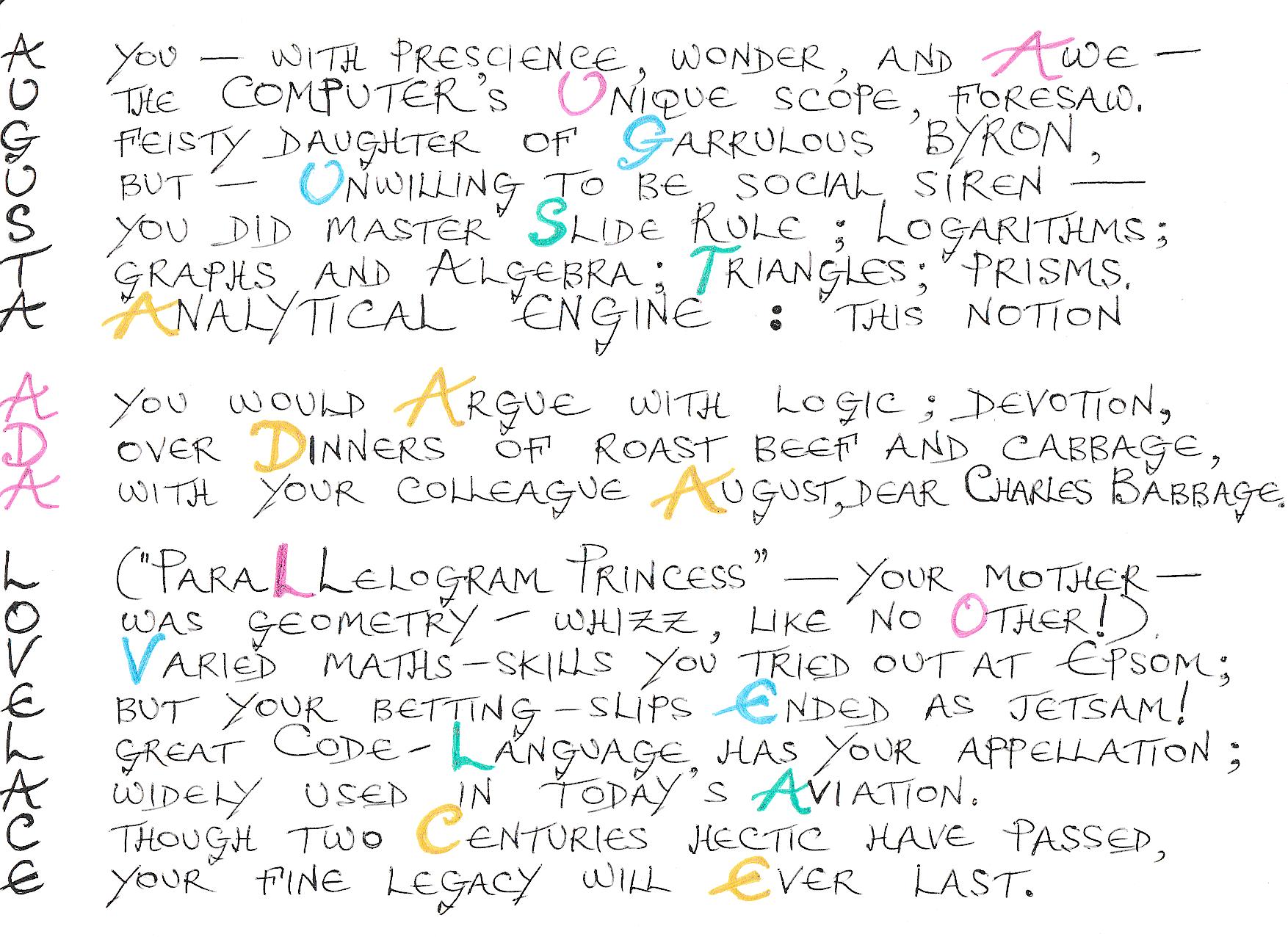
Poem for Ada Lovelace
Marion Whistle has submitted at poem to celbrate
the Lovelace bi-centenary here.
|
| October 2015 |
Fujitsu Sponsers TNMoC
Fujitsu, the global ICT provider, is supporting The National Museum of Computing
(TNMOC) by becoming a Foundation Sponsor.
The move reflects the pioneering role that Fujitsu’s predecessor companies
in the UK, such as ICL, played in the early days of the UK computer industry.
Today that history is reflected at TNMOC in the form of the Museum’s
largest computer, the ICL 2966 of the 1970s and 1980s, and its forerunners
the Elliott systems of the 1960s.
These systems have or are being restored and can be seen in operation
at the Museum..
|
| September 2015 |
ICL Technical Journal available on the web
The ICL Technical Journal was a significant series with articles about
computer and system developments in ICL and beyond.
It was published between 1978 and 2000, with 43 issues in 14 volumes.
A collaboration between Fujitsu and the National Museum of Computing
has now enabled the original journals to be published online.
Many ICL engineers, designers, developers, and technical managers wrote
articles on their work and innovations.
The articles demonstrate the enormous contribution made by ICL people
to the development of modern computing, in many cases forming the basis
of practices still in use today.
The journals can be viewed on the
Fujitsu website
.
The contents for each issue are shown and each issue can be searched using
the Adobe search tool, and you can search across the set.
There are some articles on computer history topics,
and CCS members may find the following of interest.
On ICL research and development there are three articles by
Prof. Martin Campbell-Kelly (in Volume 5 Issue 1 for 1904-1959,
Volume 6 Issue 1 for 1959-1968, and Volume 6 Issue 4 for the New Range.
These articles were subsequently published in Martin’s book on the
history of ICL).
And on the origins of the 2900 series mainframes there is an article from
1978 by John Buckle (in Volume 1 Issue 1).
|
| August 2015 |
Ada Lovelace 200th anniversary celebrations at Oxford University
In 2015 the University of Oxford will celebrate the 200th
anniversary of the birth of computer visionary Ada Lovelace.
The centrepiece of the celebrations will be a display at the
University of Oxford’s Bodleian Library (13 October - 18 December 2015)
and a Symposium (9 and 10 December 2015), presenting Lovelace’s life and work,
and contemporary thinking on computing and artificial intelligence.
For more information or to register your interest see
blogs.bodleian.ox.ac.uk/adalovelace
Ada, Countess of Lovelace (1815-1852), is best known for a remarkable article
about Charles Babbage’s unbuilt computer, the Analytical Engine.
This presented the first documented computer program, to calculate the
Bernoulli numbers, and explained the ideas underlying Babbage’s
machine and every one of the billions of computers and computer programs
in use today.
Going beyond Babbage’s ideas of computers as manipulating numbers,
Lovelace also wrote about their creative possibilities and limits:
her contribution was highlighted in one of Alan Turing’s most famous papers
Can a machine think?.
Lovelace had wide scientific and intellectual interests and studied with
scientist Mary Somerville, and with Augustus De Morgan,
a leading mathematician and pioneer in logic and algebra.
The display, in the Bodleian’s new Weston Library, will offer a chance to
see Lovelace’s correspondence with Babbage, De Morgan, Somerville and others,
and her childhood exercises and mathematical notes.
The Symposium, on 9th and 10th December 2015,
is aimed at a broad audience interested in the history and culture of
mathematics and computer science, presenting current scholarship
on Lovelace’s life and work, and linking her ideas to contemporary thinking
about computing, artificial intelligence and the brain.
Confirmed speakers so far include Lovelace’s direct descendent the Earl of
Lytton, Lovelace biographer Betty Toole, computer historian Doron Swade,
historian Richard Holmes, computer scientist Moshe Vardi and graphic novelist
Sydney Padua.
Other activities will include a workshop for early career researchers, a
“Music and Machines” event, and a dinner in Balliol College
on 9th December, the eve of Lovelace’s 200th birthday.
Oxford’s celebration is led by the Bodleian Libraries and the University
of Oxford’s Department of Computer Science, working with colleagues in
the Mathematics Institute, Oxford e-Research Centre, Balliol College,
Somerville College, the Department of English and TORCH.
Oxford has a remarkable history of programming research, with two winners of
the ACM A M Turing Award, the Nobel Prize for Computer Science,
and the unique breadth and depth of Oxford’s expertise brings a variety
of perspectives to understanding Lovelace and the remarkable intellectual
community around her, whose ideas underpin modern computing.
|
| May 2015 |
New Arrangements for Distribution of Resurrection
For the last 25 years Resurrection has been distributed free of charge
to all CCS members and generously paid for by
BCS The Chartered Institute for IT.
Over time, the membership of the CCS has increased from a few dozen
to well over a thousand, around half of whom are not BCS members.
Understandably it has been decided that this arrangement is no longer
sustainable and starting with edition number 71 we will be asking
most non-members of BCS who wish to continue to receive paper copies
of Resurrection to pay a small annual subscription of £10
for four issues of Resurrection
Current BCS members will continue to receive paper copies of
Resurrection as will former BCS members aged 60 and over who had at
least five years continuous membership of the BCS.
Of course Resurrection will continue to be freely available on the web at
www.computerconservationsociety.org/resurrection.htm.
If we have your email address you will be notified each time a new edition
is published.
If you received an explanitory note with Resurrection 69 recently
then this means that we had NOT identified you as a qualififing recipient for
free copies Resurrection in the future.
If no such enclosure was found, then you will continue to recieve Resurrection
as hitherto.
The next edition of Resurrection (Resurrection 70) will be the
last one which will go to everybody.
Non-qualifying members who want to continue to receive paper copies of
Resurrection can subscribe using the BCS online booking system at
www.bcs.org/resurrection.
CCS Members’ Email Addresses
We have recently discovered that the BCS, who maintain the CCS membership list
on our behalf, does not have email addresses for around 300 CCS members.
Until now this has been of little account, but we would like to be able
to email as many CCS members as possible,
not least to inform members each time a new edition of Resurrection
is published.
If you do not receive occasional email from us telling you about forthcoming
lectures then we don’t have your email address.
We would be grateful if you would email our esteemed membership secretary at
enclosing your name and address (so that he can accurately identify you).
Thank you.
|
| March 2015 |
Delay in Production of Resurrection 69
Although Resurrection 69 has been completed and is available on this website
here, there has been a
problem over funding for the printed version.
As members will know, Resurrection has hitherto been paid for by the BCS.
Questions have arisen within the BCS as to whether this arrangement can be allowed
to continue and whether Resurrection ought not to be an exclusively
online publication as befits a society devoted to IT.
Rest assured that relevant members of the CCS committee are addressing this
problem as a matter of urgency and we hope to bring you a printed
Resurrection 69 in due course.
In the meanwhile, please bear with us.
Annual Turing Lecture
On 23rd February, the annual Turing Lecture took place at the Royal Institution.
A recording was made and can be seen
here.
Of particuar interest to CCS members was a short introductory speech by
Alan Turing's nephew Dermot (between 2:15 and 5:30 minutes) during which
he was kind enough to give a complementary mention to “our”
replica Bombe at Bletchley Park.
|
| November 2014 |
New Gallery at the Science Museum opens
The impressive new gallery at the London Science Museum was opened at the end of
October by H.M. the Queen.
Entitled The Information Age it contains an interesting collection
covering the history of telecommunications and computing.
Of particular interest to many CCS members, will be the NPL’s Pilot Ace,
the Control Data 6600 and its Russian equivalent, the BESM6 -
each, in their time the muscle of scientific computing.
Tony Sale award winners announced
The 2014 Tony Sale award was awarded to two entries (from a field of eight) -
the IBM 1401 restoration at the Computer History Museum in California and
the creation of a virtual replica of the Zuse Z1 mecanical computer of 1938.
More detail
here.
The Imitation Game
The new film about Alan Turing was released on 14th November.
Review here.
|
| October 2014 |
CCS 25th Anniversary
This month marks a quarter of a century since the Society was
founded by Doron Swade and Tony Sale.
Now boasting over 1,000 members we feel great pride that the Society continues
to prosper and earn its place as a centre of expertise and excellence.
More detail
here.
Bombe Rebuild voted top Engineering Heritage award winner
The Bombe code-breaking machine has been voted the favourite artefact
ever to have won an Engineering Heritage Award.
More detail
here.
Termination of two MOSI Projects
It is with a heavy heart that we have to report that the authorities at the
Manchester Museum of Science and Industry have decided to terminate the
Hartree Differential Analyser Project and the Pegasus Peripherals Project
as they no loinger fit in with the museum's future plans.
We understand that the Computing Gallery will be closed.
A sad day for us all especially for Charles Lindsey, Brian Russell, Dave Wade
and the other team members.
|
|
| September 2014 |
Forthcoming Redesign of the Maths/Computer Gallery at the London Science Museum
On September 12th, it was announced that the present Computer/Mathematics
Gallery at the London Science Museum has attracted a donation of no less that £5,000,000
from one David Harding founder of Wilton Capital Management, a hedge fund company.
The new gallery which is due to open in late 2016, will replace the current gallery.
Planning is at an early stage, but we hear that Pegasus is not likely to remain,
nor the Babbage Difference Engine.
On the other hand the Powers-Samas punched card office is thought to have been
included in the initial plans and there is a possibility that the Elliott 401
may be put on public display for the first time.
More detail
here.
|
|
| March 2014 |
Announcement of The Alan Turing Institute
In his budget speech, the Chancellor, George Osborne announced the creation of
The Alan Turing Institute which is to be a new research organisation to
investigate methods of analysing huge quantities of "Big Data"
to find patterns.
A budget of £42,000,000 has been allocated to support this work.
Organisations, including existing universities, will be invited to bid for the new
institute later in the year.
At least two Alan Turing Institutes have been set up previously, one in Holland and
another by the late Donald Michie in Glasgow in 1983 which latter closed in 1994
(a fact which seems to have escaped the notice of the Daily Telegraph)
due to lack of clients.
Manchester MP John Leech immediately suggested that Manchester University would be an
appropriate site for the new organisation, saying
"Alan Turing's contribution to Manchester was enormous...".
CCS members will, no doubt, have their own views about that.
|
|
| February 2014 |
Disagreements at Bletchley Park/National Museum of Computing
At the end of January a dispute between TNMoC and the Bletchley Park Trust which has been brewing for some
time burst into the open as a result of a BBC News report which can be viewed at
www.bbc.co.uk/news/uk-25916048.
A comprehensive summary of the dispute may be found at tinyurl.com/tnmocvsbpt.
CCS is closely related to both TNMoC and BPT and feels that it would be inappropriate at this stage to comment.
We hope the dispute can be resolved without further adverse effects to both parties.
In the meantime, we feel obliged to let members know what is going on.
|
|
| November 2013 |
Alan Turing Pardon
Alan Turing was granted a posthumous Royal pardon on Christmas Eve.
This follows a long campain to have his 1952 conviction for gross indecency set aside.
Reaction was generally positive.
Iain Standen, head of the Bletchley Park Trust opined
"Turing was a visionary mathematician and genius whose work contributed
enormously both to the outcome of the war and the computer age"
Turing's biographer, Andrew Hodges was less effusive -
"Alan Turing suffered appalling treatment 60 years ago and there has been a very well intended and deeply
felt campaign to remedy it in some way.
Unfortunately, I cannot feel that such a 'pardon' embodies any good legal principle.
If anything, it suggests that a sufficiently valuable individual should be above the law which applies to everyone else.
...... For me, this symbolic action adds nothing.
A more substantial action would be the release of files on Turing's secret work for GCHQ in the cold war.
Loss of security clearance, state distrust and surveillance may have been crucial factors in the two years
leading up to his death in 1954."
|
|
| November 2013 |
The National Museum of Computing
has been pledged its largest-ever single donation of £1 million and is seeking
the required matched funding to double its value.
The donation will be phased as matching funding is received and will enable the Museum
to develop its enormous potential.
Early priorities include refurbishing the Museum and increasing its capacity for
visitors and exhibits.
The donor, Matt Crotty, a technology entrepreneur and a trustee of TNMoC, said;
"To help the development of a Museum such as this is an exceptional opportunity
that comes once in a lifetime.
I have watched this organisation grow and make astonishing achievements with very
limited funding.
My decision to donate has also been motivated by the increasing public awareness
of the significance of digital heritage and the role and understanding it can play
in inspiring current and future generations to become engineers and
computer scientists."
|
|
| August 2013 |
The Centre for Computing History
has recently completed its long-awaited relocation from Haverhill to Cambridge.
Their website gives details.
|
|
| July 2013 |
A poem of praise for Alan Turing
CCS member Marion Whistle has composed a short poem remembering
the life of Alan Turing here.
|
|
| April 2013 |
Innovation Poll
The Science Museum and other similarly distinguished organisations have recently held
a poll to determine the most important British innovation of the last 100 years.
Turing's notion of the "universal" computer was voted first out of 87
with the World Wide Web coming in at number six.
More details here.
|
|
| March 2013 |
A History of the History of Bletchley Park and Colossus
In February Professor Brian Randell visited the National Museum of Computing at
Bletchley Park and, in front of the rebuilt Colossus,
gave a fascinating talk on how, in the early 1970s,
he uncovered the then secret of Bletchley Park and Colossus.
Crossing swords with the security services and the then Prime Minister,
Professor Randell slowly teased out the truth of the long hidden world of Bletchley Park.
Now available on video here.
|
|
| November 2012 |
Harwell Decatron ReBoot
After a three-year restoration project at The National Museum of Computing,
the Harwell Dekatron (aka WITCH) computer was rebooted on 20th November 2012
to become the world's oldest original working digital computer.
Now in its seventh decade and in its fifth home,
the computer with its flashing lights and clattering printers and readers provides
an awe-inspiring display for visiting school groups and the general public
keen to learn about our rich computer heritage.
The 2.5 tonne, 1951 computer from Harwell with its 828 flashing Dekatron valves,
480 relays and a bank of paper tape readers clattered back into action in the
presence of two of the original designers,
one of its first users and many others who have admired it at different times during
its remarkable history.
Kevin Murrell, trustee of TNMOC who initiated the restoration project, said:
"In 1951 the Harwell Dekatron was one of perhaps a dozen computers in the world,
and since then it has led a charmed life surviving intact while its contemporaries
were recycled or destroyed.
As the world's oldest original working digital computer,
it provides a wonderful contrast to our Rebuild of the wartime Colossus,
the world's first semi-programmable electronic computer."
The Harwell Dekatron computer first ran at Harwell Atomic Energy Research Establishment
in 1951 where it automated the tedious calculations performed by talented young
people using mechanical hand calculators.
Designed for reliability rather than speed, it could carry on relentlessly for days
at a time delivering its error-free results.
It wasn't even binary, but worked in decimal -- a feature that is beautifully
displayed by its flashing Dekatron valves.
By 1957, the computer had become redundant at Harwell,
but an imaginative scientist at the atomic establishment arranged a competition
to offer it to the educational establishment putting up the best case for its
continued use. Wolverhampton and Staffordshire Technical College won,
renamed it the WITCH (Wolverhampton Instrument for Teaching Computation from Harwell)
and used it in computer education until 1973.
After a period on display in the former Birmingham Museum of Science and Industry,
it was dismantled and put into storage,
but "rediscovered" by a team of volunteers from The National Museum
of Computing in 2008.
With the blessing of the Birmingham museum and in conjunction with the
Computer Conservation Society,
the team developed a plan to restore the machine and to put it once again to
educational use at TNMOC.
Kevin Murrell recalls its rediscovery:
"I first encountered the Harwell Dekatron as a teenager in the 1970s when
it was on display in the Birmingham Museum of Science and Industry --
and I was captivated by it.
When that Museum closed, it disappeared from public view,
but four years ago quite by chance I caught a glimpse of its control panel
in a photograph of stored equipment.
That sparked our ideas to rescue it and we hunted it down."
"The TNMOC restoration team has done a superb job to get it working again
and it is already proving to be a fascination to young and old alike.
To see it in action is to watch the inner workings of a computer --
something that is impossible on the machines of today.
The restoration has been in full public view and even before it was working again
the interest from the public was enormous."
Delwyn Holroyd, a TNMOC volunteer who led the restoration team, said:
"The restoration was quite a challenge requiring work with components like valves,
relays and paper tape readers that are rarely seen these days and are certainly not
found in modern computers.
Older members of the team had to brush up on old skills while younger members had
to learn from scratch!"
Here is a report from
the BBC news website featuring Kevin and Delwyn talking about the machine.
You can find more information on the machine here.
|
|
| October 2012 |
Tony Sale Award 2012
The Tony Sale Award, sponsored by Google, was set up to recognise singular
engineering achievements in the area of computer conservation achievements
in the growing area of computer conservation.
The first Award was presented at a ceremony held on 11th October, at the BCS, London.
The winning project is the Ferranti Mark 1 LoveLetters, reconstruction of software
for text generation submitted by Dr David Link who is based in Cologne.
This computer art installation is a functional replica of the 1951 Ferranti Mark 1
computer.
David Link reconstructed software developed by one of the very first software developers.
In 1953-1954, using the programming system devised by Alan Turing,
Christopher Strachey used the built-in random generator of the Ferranti Mark 1
to generate texts intended to express and arouse emotions - or,
automated 'love letters'.
The project's fusion of art, engineering and history celebrates one of the first
artistic applications of the computer in a visually attractive way.
It is conceptually brilliant and technically impressive in its research and
reconstruction, with wide cultural appeal, originality and a touch of genius.
Even more details here.
|
|
| October 2012 |
Pegasus arises
Wonderful news from Len Hewitt, Project Leader for Pegasus. He writes:
We had our first switch on of Pegasus for 3¼ years yesterday.
Peter Burton the engineer the Science Museum is employing
to prove the machine is safe to run needed to have the machine running for a couple
of hours for him to record temperatures and voltages in various areas.
Chris Burton, Peter Holland, Rod Brown and I attended from the C.C.S. with
Charlotte Connelly from the Science Museum.
We had some minor problems which were overcome.
One was a fuse blowing episode in the CPU caused by the back wiring being
disturbed in cleaning but this was rectified.
We ran with HT on for over an hour with some packages unplugged just to
check voltages and temperatures.
Then, after some minor repairs, we ran for another hour with all packages in
and we were able to do drum transfers,
execute instructions on the hand switches and Start And Run attempted
to read paper tape from the Tape Reader.
The machine appears to be 95% working.
The air conditioning engineers need to gas up the system and we are trying to
persuade the Museum to let us do this before I leave on the 1st November
as the air conditioning engineers need power on to gas up the system.
We were all delighted at the progress and it speaks volumes about the initial design of the system.
Meanwhile members will also be interested to hear that a new book on Pegasus by
Hugh McGregor Ross and Colleagues has just been published.
Entitled "Pegasus The Seminal Early Computer" it traces the ancestry of the design back
to Elliotts and forward to the ICT 1900.
Full of technical detail, it costs a modest £9.95.
|
|
| August 2012 |
The Society was saddened to learn of the death of its past Chairman, BrianOakley CBE on Friday 17th August.
Brian Oakley spent most of his career as a highly regarded civil servant in the 1960's Ministry of Technology and its successors specialising in information technology. He was the chief official of the Science and Engineering Research Council, BCS President (1988-9) and chaired the board of the University of London Computer Centre (ULCC). He is best known as the Director of the Alvey Programme (1983-7) the UK government's response to the Japanese 5th Generation Computer project.
But it is as our Chairman from 1996 to 2000 that we shall remember him. He remained on the Society's committee until 2003 and was still attending meetings in 2012. In due course a full obituary will appear in Resurrection.
|
|
| May 2012 |
Another Vintage Computer Festival? - See here for more details about this exciting event! |
|
| August 2011 |
Tony Sale 1931-2011
The CCS is sad to announce the death of Tony Sale. Tony was a founder member of the CCS and has been a committee member since. Tony is of course most well known for his rebuilding of the Colossus code-breaking computer at Bletchley Park.
There is more information on the BBC”s website here. |
|
| July 2011 |
Computer Conservation Society Projects feature in royal visit to Bletchley Park
On Friday 15 July, the Queen and Duke of Edinburgh visited Bletchley Park to meet some of the veterans involved in the World War II code-breaking achievements. As part of the visit, the Bombe reconstruction was demonstrated to the Queen by Jean Valentine, one of the veterans who regularly shows the machine to visitors; while John Harper, leader of the Bombe team, explained about the machine's reconstruction to the Duke of Edinburgh.
The visit also included a visit to the National Museum of Computing which included a demonstration of the Colossus rebuild by Tony Sale. |
|
| June 2010 |
Britain´s largest celebration of vintage computing is to be held at The National Museum of Computing (TNMOC)
in Bletchley Park from 19-20 June 2010.
Vintage Computing Festivals originated ten years ago in California´s Silicon Valley to celebrate our computing heritage, and are now regular events held across the USA and in Germany. The June 2010 event at TNMOC will be the first in the UK and will pay particular tribute to the British contribution to the development of computing.
The festival is open to all, and will be of particular interest to CCS members. The event includes many exhibition stands, a full lecture programme, machine demonstrations, computer games and challenges, bring-and-buy sale, and performances of electronic music.
|
|
| 17th September 2009 |
We have decided to reschedule our CCS event marking the 50th anniversary of the Pegasus computer in the Science Museum from December to May 2010. There is a risk that the repairs would not be completed in time - see the following statement from the Science Museum.
"On Wednesday 29th July 2009 there was a small electrical fire in the Pegasus computer during its demonstration by CCS volunteers on gallery. As a result of the incident all demonstrations of the Ferranti Pegasus computer, and the 401 working party at Blythe House, are currently suspended. The museum is conducting a formal investigation into the actions of staff post incident, the management of hazards, particularly asbestos within the Museum's collection, and the supervision and training of volunteers. At the end of this investigation a report will be completed, so that NMSI management can have complete assurance that any future activities of the CCS or other operators are planned, operated and supervised within legal requirements of Health and Safety and NMSI Health and Safety policy. CCS volunteers are thanked for their patience and cooperation during the investigation and in the implementation of its outcomes." |
|
| 5th September 2009 |
Joint event between the CCS and the BCS Edinburgh Branch to be held on 22nd September at the University - on JANET - the first 25 years. See event page. |
|
| 3rd September 2009 |
A new CCS working party has been formed to restore the Harwell Dekatron Computer - which in later life became known as the WITCH computer. The machine has been moved from storage in Birmingham to The National Museum of Computing where the project is based. Click here more information about the computer, and click here for more information about the museum project. |
|
| 12th August 2009 |
Demonstrations of the Ferranti Pegasus computer are currently suspended, following an electrical fault in the machine. The Science Museum is investigating the causes of this fault and its implications. On completion of the investigation we hope to be able to repair the machine in time to celebrate its 50th anniversary. If repair is possible we currently anticipate that gallery demonstrations will recommence according to their regular schedule: fortnightly on a Wednesday, between 11 - 3pm on a date to be decided. |
|
| 22nd July 2009 |
A new issue of Resurrection has been posted to all members - No 47 Summer 09 |
| 1st July 2009 |
CCS founder Tony Sale honoured by The Open University for his work on Colossus - more here |
| 12th June 2009 |
The Science Museum announces Centenary Events (dead hyperlink - http://www.sciencemuseum.org.uk/Centenary/Home/Whats_on.aspx) - and you can vote for one of 10 Centenary Icons (dead hyperlink - http://www.sciencemuseum.org.uk/Centenary/Home/Icons.aspx) - computers are represented by the Pilot ACE. |
| 14th May 2009 |
The CCS held it's AGM on May 14th - Click here for more details. |
| 12th May 2009 |
Early ICT 1301 computer alive and well in Kent - now a CCS working group and demonstrated on a CCS visit. |
| April 2009 |
Bombe Restoration Project receives major Heritage award - click here for more |
| 1st March 2009 |
Issue 45 of Resurrection has now been posted to all members. |
| 1st January 2009 |
CCS Founder honoured - Dr Doron Swade awarded a MBE for services to the History of Computing.
Doron Swade inspired the founding of the Computer Conservation Society, and has been on our committee since the birth of the Society in 1989.
Doron is best known for his research and leadership on projects to build historically accurate 'Babbage Engines' - for more see a recent BBC news item.
Doron's recent work on exhibiting and communicating the overall history of computing was then topic of a recent talk to the Society - and stimulated much discussion among members.
The Society congratulates Doron on this award. |
| 20th November 2008 |
Issue 44 of our bulletin`Resurrection' has been posted to CCS members.
A contents list for previous issues of Resurrection has also been added to the society web site. |
| 25th August 2008 |
Issue 43 of our bulletin`Resurrection' has been posted to CCS members. Please contact the society secretary if you have not received your copy. |
| 15th August 2008 |
The Summer 2008 Issue of our bulletin`Resurrection' has been posted to CCS members. |
| 21st July 2008 |
CCS chairman David Hartley, acting on behalf of the President of the BCS, presented medals to UK computer pioneers at the Digital60 day Manchester.
Chris Burton was also presented with a medal to to mark his leadership of the of the Baby replica re-build, on the 10th anniversary that achievement. |
| 30th June 2008 |
Our CCS events page now has details from Autumn 08 onwards. |
| 20th June 2008 |
David Caminer - Computer Systems Pioneer and personality - died 19th June aged 92
The Leo Society website has a web document with links to a number of obituaries. |
| 18th Jun 2008 |
Other events open to CCS members
9th July National Archive of Educational Computing event in London - New Learning '08 - Connecting the Future to the Past - free but booking required.
13th July Visit the restored ICT 1301 computer - a working second generation mainframe from the 1962 era, on public display in a barn at a classic car show in Kent.
22nd - 24th July BCS Computer Arts Society Specialist Group - EVA London 2008 conference on Electronic Visualisation and the Arts at the BCS Southampton Street, London - booking required. |
| 27th May 2008 |
New CCS event in Manchester on Friday 20th June at 14:30 - a Celebratory Seminar open to all on the history of computing and the influence of Manchester computer designs - part of the Digital 60 anniversary celebrations of the first stored program computer. |
| 27th May 2008 |
Announcement about the CCS Bulletin - a tribute to our editor.
Thanks to Nicholas Enticknap for his excellent work as editor of our publication 'Resurrection', for 42 issues over 18 years.
Nicholas is handling over to our new editor, Dik Leatherdale.
Issue 42 has been completed by Nicholas, and will soon be sent out to Society members. You can also view Resurrection issues online.
|
| 18th Apr 2008 |
The CCS March seminar on the legacy of the BBC Microcomputer is the subject of an article in Personal Computer World (dead hyperlink - http://www.pcw.co.uk/personal-computer-world/news/2214644/beeb-helped-conquer-world-3924960) - it includes a story about the origins of the ARM chip. There was also a leader story in The Guardian. |
| 20th Mar 2008 |
An excellent CCS event on Thursday 20th March about the innovative BBC computer education and Computer project, and what it led into - from the people who made it all happen - for more in the BBC news coverage click here for the interviews and also here for more coverage. |
| 7th Mar 2008 |
Manchester CCS meeting on 18th March - start time brought forward to 17:00 - click here for more details |
| 4th Mar 2008 |
The Bombe rebuild web site has been updated with additional material following completion of the rebuild project - click here for more details |
| 28th Feb 2008 |
A BCS Oral History Project meeting on 'Women of Station X' on 7th March may be of interest to CCS members - click here for more details |
| 27th Jan 2008 |
Our new CCS Events page has been updated with details on events in February and March - click here for more details |
| 14th Jan 2008 |
Our links page now includes a link to the ICL archive catalogue housed at the Science Museum |
| 17th Dec 2007 |
John Harper, leader of the Bombe Rebuild team receives Honorary Fellowship of the BCS - Click here for more details |
| 14th Nov 2007 |
The National Museum of Computing launch their cipher challenge - Click here for more details from the museum
For more information about the project click here for a BBC Page covering the Colossus Challenge |
| 3rd Sep 2007 |
More detail is now available for each of our public lectures. |
| 17th Jul 2007 |
Completed Bombe rebuild Project officially opened by the Duke of Kent - click for more details |
|
|
|
|